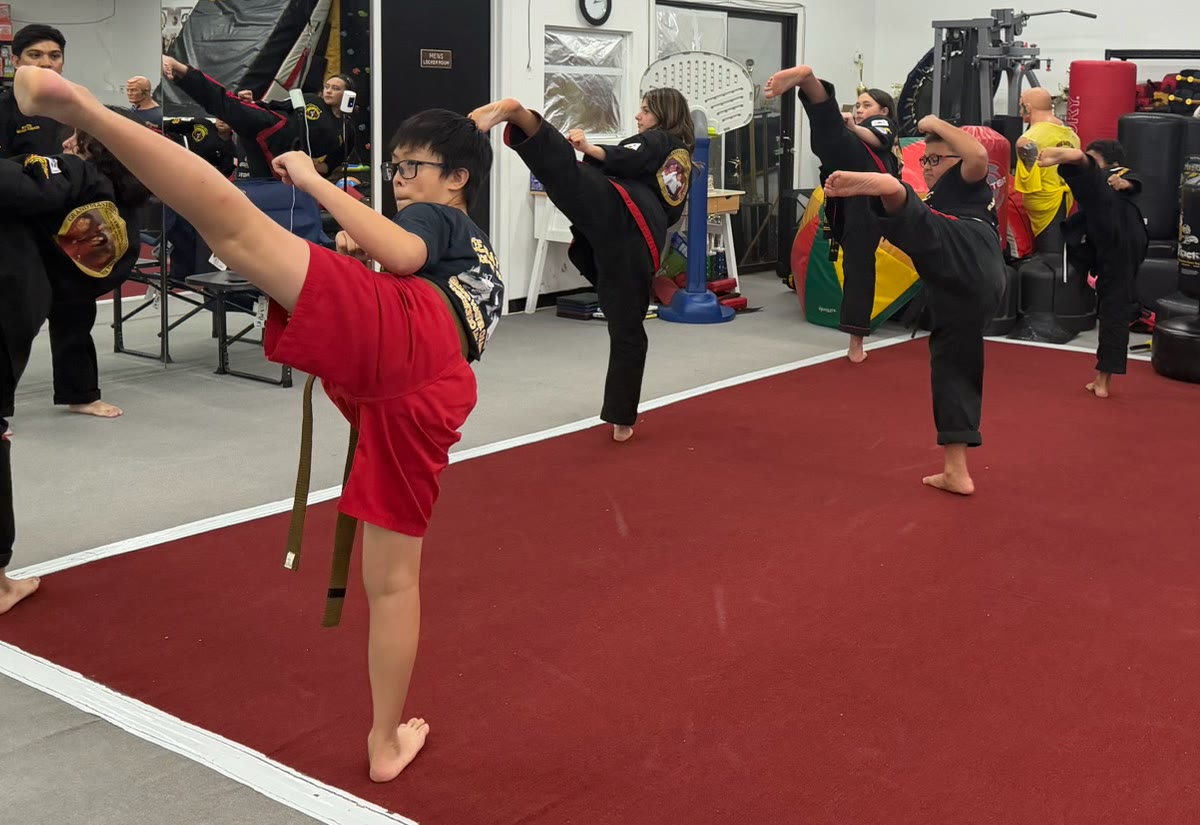
To do a back kick, keep your back to the target, look over your shoulder to find it, lift the knee of the kicking leg and drive the heel straight back at the target in a line. From a fighting stance the target is in front, so a half turn comes first, and the kick with that turn is often called a spinning back kick or a turning back kick. A child should learn it in class, under an instructor, before practicing it at home.
Chung TKD in New Hyde Park teaches Tae Kwon Do, a Korean martial art also written taekwondo, to children ages 2 to 13, in three programs by age: Pee-Wee, Children and Youth. Grandmaster Howard Chung, 9th Dan, has taught Tae Kwon Do since 1970 and opened the school in 1984. This guide is by Master Chris J. Chung, 5th-degree black belt.
How does a back kick move?
Straight back, heel first, at a target behind the kicker. Wikipedia's Kick entry describes it as a kick directed backwards, with the kicking leg kept close to the standing leg and the heel as the striking surface, and gives turning back kick as one of its other names. Wikipedia's list of taekwondo techniques describes the Tae Kwon Do back kick with the turn built in. There the kicker turns away from the target, watches it over the shoulder and pushes the back leg straight at it, heel first. It is one of the five basic kicks in our guide to the basic Tae Kwon Do kicks.
What is a back kick called in Korean?
Dwi chagi, also written dwit chagi. Wikipedia's list of taekwondo techniques spells it dwit chagi, the Kick entry writes it dwitchagi, and the Fight Encyclopedia gives dwi chagi and translates it as back kick. Chagi means kick.
Is a back kick the same as a spinning back kick?
Often, but not always. A back kick is the heel driving straight back at a target behind the kicker, and when the target is already behind, there is no turn. When the target is in front, as it is from a fighting stance, the kicker first turns their back to it, and that half turn makes it a spinning back kick. The Fight Encyclopedia describes the spinning version as a pivot on the front foot, a turn of the body while finding the target over the shoulder, and the back leg driving straight back as the turn finishes.
How do you do a spinning back kick, step by step?
Here are the six steps for a spinning back kick from a fighting stance, kicking with the back leg.
- Stand in a fighting stance, side-on to the target, with the kicking leg in back and both hands up.
- Look over your shoulder to start the turn, then pivot on the front foot so the body follows, turning away from the target until your back faces it.
- Find the target over your shoulder before the leg moves.
- Lift the knee of the kicking leg, keeping it close to the standing leg.
- Drive the heel straight back at the target in a line, with the toes pointing down.
- Pull the leg back in, then set the foot down under control, back in a fighting stance, side-on to the target with both hands up.
Our guide to Tae Kwon Do stances shows the fighting stance the kick starts from.
How is a back kick different from a side kick?
By which way the body faces and how the foot is turned. In a side kick the leg drives out to the side in a line and lands with the outside edge of the foot or the heel, as the Kick entry describes. In a back kick the body turns further, so the back faces the target, the eyes look over the shoulder, and the heel drives straight back with the toes pointing down, which Wikipedia's list calls a true back kick.
How is a spinning back kick different from other spinning kicks?
By the path the leg takes. A spinning back kick drives the heel straight back in a line. A spinning hook kick swings the leg around in a wide arc, and a tornado kick turns a full circle, usually with a jump, before a roundhouse kick, as our guides to how to do a crescent kick and how to do a tornado kick explain. The Fight Encyclopedia's back kick entry says that hooking the leg around instead of driving it straight back makes it a spinning hook kick, a different kick.
What should I look for when my child does a back kick?
Watch five things, from the start of the kick to the finish.
- The turn. The body turns until the back faces the target, and stops there instead of turning past it.
- The look. The eyes find the target over the shoulder before the leg moves.
- The knee. The knee of the kicking leg lifts close to the standing leg instead of swinging out to the side.
- The line. The heel drives straight back at the target, with the toes pointing down, instead of curving around.
- The finish. The leg comes back in and the foot lands under control, back in a fighting stance with the hands up.
Praise a clean look and a straight line, not how high the leg went. If something looks off, ask an instructor after class rather than correcting it at home.
What are the common mistakes in a back kick?
Each one undoes one of the five things on the watch list above.
- Turning too far, so the body ends up sideways or facing the wrong way.
- Kicking without looking, so the kick goes out blind.
- Swinging the knee out wide, so the leg starts a circle instead of a line.
- Hooking the leg around instead of driving it straight back, which makes it a spinning hook kick.
- Leaving the leg out behind after the kick, or spinning on through and losing balance.
How can my child practice a back kick safely at home?
By learning it in class first, then kicking in the air, in a clear space. Go through this checklist with your child before practice.
- Your child has learned the back kick in class, from an instructor.
- There is clear space all around, behind as well as in front, since the body turns and the kick goes out behind it.
- Your child looks behind before turning, to check that the space is clear, and finds the spot they are kicking at over the shoulder before every kick.
- Your child is barefoot rather than in socks, since socks slip in the turn.
- Kicks go in the air, never at a person, a pet or anything hard.
- Turns start slow, and speed comes when an instructor says so.
- The jumping back kick, a back kick thrown from a jump, waits until an instructor has taught it in class and says your child is ready to practice it at home.
Any kicking with a partner waits for class and an instructor, and our guide to Tae Kwon Do sparring for kids explains how partner practice works.
How does my child learn the back kick?
In class, under an instructor. At Chung TKD, the school's instructors teach the classes, and classes also cover the ITF forms, called hyung, and self-defense. Ask an instructor after class which kicks your child is working on.
Where is Chung TKD?
Chung TKD is at 1527 Jericho Turnpike, New Hyde Park, NY 11040.
How do we get started?
Start with the two free trial classes. A parent or guardian stays for both, and kids wear something comfortable, sweats or shorts. Book a free class online.
Questions parents ask
What part of the foot hits in a back kick?
The heel. The leg drives straight back with the toes pointing down, so the heel leads.
Why do you look over your shoulder in a back kick?
To see the target. The kicker's back faces the target, so the eyes find it over the shoulder before the leg moves, and a kick without a look goes out blind.
What does dwi chagi mean?
Back kick. Dwi chagi, also written dwit chagi, is the Korean name for the back kick, and chagi means kick.
Is a back kick the same as a side kick?
No. A side kick goes out to the side, while a back kick goes straight back with the back to the target, the toes pointing down and the eyes over the shoulder.
Can my child practice back kicks at home?
Yes, once an instructor has shown them the kick in class. Look behind before turning, kick in the air, in a clear space, barefoot, and never at a person.