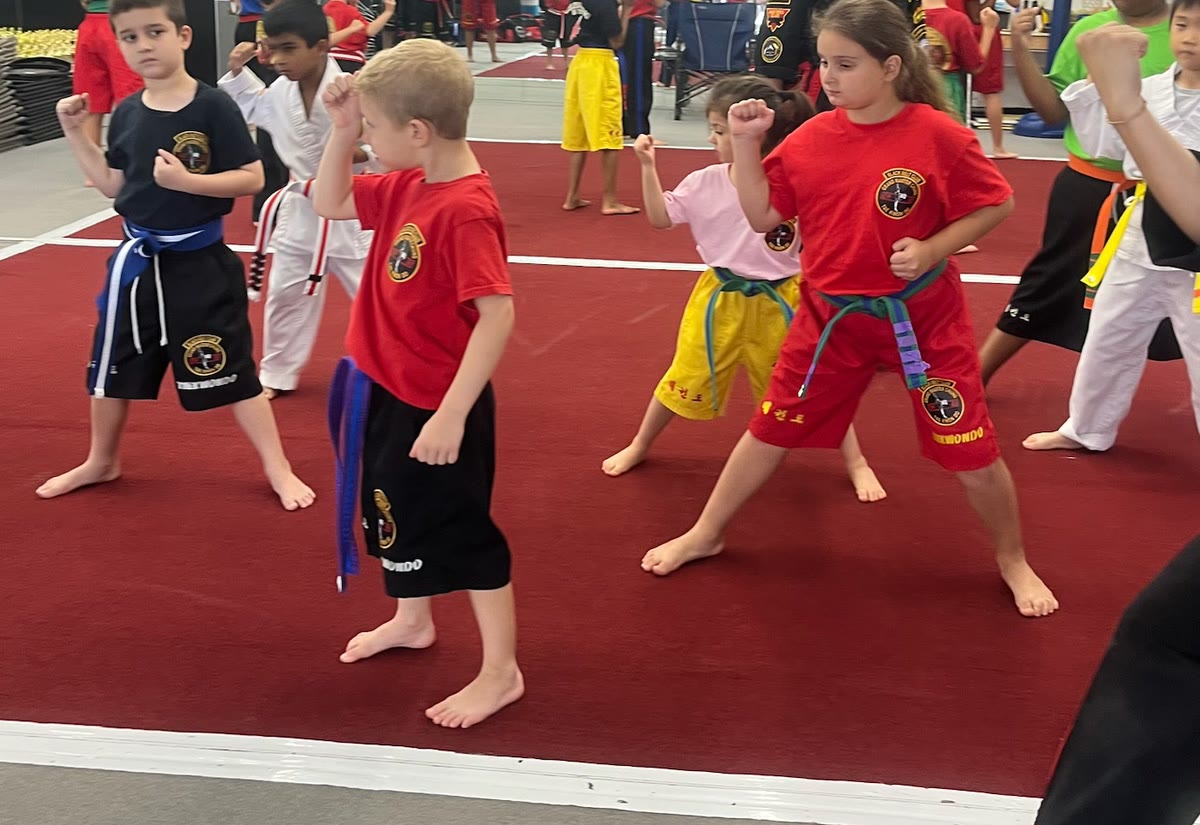
The basic Tae Kwon Do blocks are the low block, the inside and outside middle blocks, the high block and the knife-hand block, called arae makgi, an makgi, bakkat makgi, eolgul makgi and sonnal makgi in Korean, though the names vary from school to school. A Tae Kwon Do block meets a kick or punch with the forearm or the edge of the hand and stops it or turns it aside, and in the basic blocks the other hand pulls back to the hip as the block lands. A child learns Tae Kwon Do blocks in class, under an instructor, and practices them in the air, or with a partner who moves slowly under an instructor, never at full speed at a person.
Chung TKD in New Hyde Park teaches Tae Kwon Do, a Korean martial art also written taekwondo, to children ages 2 to 13, in three programs by age: Pee-Wee, Children and Youth. Grandmaster Howard Chung, 9th Dan, has taught Tae Kwon Do since 1970 and opened the school in 1984. This guide is by Master Chris J. Chung, 5th-degree black belt.
What is a block in Tae Kwon Do?
A move that stops or turns aside a kick or punch, most often with the forearm. Wikipedia's list of taekwondo techniques says blocks, called makgi or makki, are used to stop and deflect an incoming strike, and that they often include a pulling hand, the other hand drawn back to the hip. Makgi is pronounced mahk-gee.
What are the low, middle and high blocks?
They are the three levels of blocking, named for three sections of the body. The same list gives their Korean names as arae makgi, momtong makgi and eolgul makgi, which is also written olgul makgi, and in Korean arae means low, momtong the trunk of the body and eolgul the face. The blocking arm finishes above the front knee in a low block, in front of the chest in a middle block and above the forehead in a high block. ITF terminology uses other words for the levels, najunde for low, kaunde for middle and nopunde for high, so ask an instructor which names your child hears in class.
How do you stand for the blocks?
In a front stance. One foot is well in front of the other, the front knee is bent, the back leg is straight and the hips face forward. Each block below uses the front arm, the one on the same side as the front foot, and schools vary in the details, so follow what your child's instructor shows. Our guide to Tae Kwon Do stances shows the front stance and the others.
How do you do a low block, step by step?
The low block, arae makgi, sweeps the forearm down across the body. Here are its four steps.
- Stand in a front stance, with both hands in fists.
- Bring the blocking fist up to the opposite shoulder, palm facing in, and reach the other arm down and forward across the body.
- Sweep the blocking arm down and across the body in an arc, while the other fist pulls back to its hip, palm up.
- Stop the blocking fist about two fists' width above the front knee, palm down, with the wrist straight.
How do you do an inside middle block, step by step?
The inside middle block, an makgi, swings the forearm inward across the front of the body. In Korean, an means inside. Here are its four steps.
- Stand in a front stance, with both hands in fists.
- Lift the blocking fist out to the side, at ear level, with the elbow bent and the palm facing forward, and reach the other arm forward.
- Swing the blocking arm forward and inward across the front of the body, while the other fist pulls back to its hip.
- Stop the blocking fist in front of the middle of the chest, at shoulder height, with the elbow bent and the palm facing the body.
How do you do an outside middle block, step by step?
The outside middle block, bakkat makgi, swings the forearm outward, and the outside of the forearm does the blocking. In Korean, bakkat means outside. Schools start it in different places. The steps below cross the forearms first, and Wikipedia's list starts it with the fist at the hip. Here are its four steps.
- Stand in a front stance, with both hands in fists.
- Cross the forearms in front of the chest at shoulder height, palms facing in, with the blocking arm on the outside.
- Swing the blocking arm outward across the chest, while the other fist pulls back to its hip.
- Stop the blocking fist at shoulder height, in front of the shoulder on the same side, with the elbow bent, the wrist straight and the outside of the forearm facing out.
How do you do a high block, step by step?
The high block, eolgul makgi, raises the forearm up past the face. Here are its four steps.
- Stand in a front stance, with both hands in fists.
- Bring the blocking fist low, across the belt, palm up, under the other arm, which crosses in front of the chest.
- Raise the blocking arm up past the face, while the other fist pulls back to its hip.
- Stop the blocking arm above and in front of the forehead, about a fist's width away, with the forearm angled and the elbow up.
How do you do a knife-hand block, step by step?
The knife-hand block, sonnal makgi, blocks with the edge of the open hand instead of the forearm. To make a knife hand, open the hand, hold the fingers tightly together, tuck the thumb in against the palm and keep the wrist straight. Here are the four steps.
- Stand in a front stance, with the blocking hand open as a knife hand.
- Cross the forearms in front of the chest, with the open blocking hand on the outside, near the opposite shoulder, palm facing in.
- Sweep the blocking hand across the body in an arc, from the inside to the outside, while the other hand pulls back to its hip.
- Stop the knife hand at shoulder height, with the elbow bent, the wrist straight and the edge of the hand facing out.
Wikipedia's Knifehand strike entry says that in many Japanese, Korean and Chinese styles, the knife hand is used to block as well as to strike. Our guide to how to make a fist and throw a punch shows the fist the other blocks use.
How can I tell the five blocks apart?
Watch where the blocking arm starts and where it stops. Here is what to look for in each.
- Low block. It starts at the opposite shoulder and stops above the front knee.
- Inside middle block. It starts beside the ear and stops in front of the middle of the chest.
- Outside middle block. In the steps above it starts crossed in front of the chest, and it stops in front of the shoulder on its own side.
- High block. It starts low across the belt and stops above the forehead.
- Knife-hand block. It moves like the outside middle block, but with an open hand, and the edge of the hand faces out at the finish.
Why do the inside and outside block names get mixed up?
Because schools do not all use them the same way. Here, as in Wikipedia's list, which calls them the inward and outward blocks, the inside block swings inward and the outside block swings outward. Some schools name a block by the part of the forearm that blocks instead, and Wikipedia's Blocking entry uses inside and outside in yet another way. Ask an instructor which name your child's class uses for each.
What should I look for when my child does a block?
Watch four things, in order: the start, the path, the finish and the other hand.
- The start. The blocking arm begins in its starting position, such as the opposite shoulder for a low block.
- The path. The arm travels in one smooth motion across the body, staying close to it, not swung wide.
- The finish. The arm stops at the level the block calls for, low, middle or high, with the fist tight and the wrist straight.
- The other hand. It pulls back to its hip at the same moment the block lands, and stops there.
Praise a clean start and a still finish, not how fast the block was. If something looks off, ask an instructor after class rather than correcting it at home.
What are the common mistakes in Tae Kwon Do blocks?
Each one misses a point of the watch list above.
- Skipping the start, so the arm moves straight to the finish without its starting position.
- Swinging the arm wide, out past the side of the body, instead of keeping it close.
- Letting a low block hit the thigh, instead of stopping it in the air about two fists' width above the knee.
- Bending the wrist at the finish, instead of keeping it straight.
- Leaving the other hand out in front instead of pulling it back to the hip.
How do you block a punch in Tae Kwon Do?
With the forearm, by turning the punch aside, and each block on this page does that at its own level, low, middle or high. In class, students practice blocks in the air first, then with a partner who punches slowly, under an instructor, and never at full speed.
How can my child practice blocks at home?
In the air, once an instructor has shown them the blocks in class. Go through this checklist with your child before practice.
- Your child has learned the block in class, from an instructor.
- There is clear space all around, since the arms sweep across and out from the body.
- Your child is barefoot, since bare feet grip better than socks on a smooth floor.
- Blocks go in the air, never against a person, and partner practice waits for class.
- Each block goes slowly from its start to its finish, and speed comes after the shape is correct.
- A mirror helps your child check the finish and the other hand.
Our guide to practicing Tae Kwon Do at home covers what else to practice between classes.
Where do blocks show up in Tae Kwon Do?
In the forms, in partner practice and beside the kicks and punches. A form, called hyung, is a set pattern of blocks, kicks and strikes that a student learns by heart, and at Chung TKD color belts learn the ITF forms and black belts learn the forms Kwang-Gae and Koryo. Our guides to Tae Kwon Do forms and to the basic Tae Kwon Do kicks cover the rest.
Are Tae Kwon Do blocks the same as karate blocks?
Some share an English name. Wikipedia's Blocking entry says karate calls these techniques uke waza and Tae Kwon Do calls them makgi, and it names a rising block in both arts, called age uke in karate. The same entry says styles, types and names of blocks vary widely among the martial arts.
How does my child learn the blocks?
In class, under an instructor. At Chung TKD, the school's instructors teach the classes, and classes also cover the ITF forms and self-defense. Our page on self-defense for kids explains how self-defense fits into class. Ask an instructor after class which blocks your child is working on.
Where is Chung TKD?
Chung TKD is at 1527 Jericho Turnpike, New Hyde Park, NY 11040.
How do we get started?
Start with the two free trial classes. A parent or guardian stays for both, and kids wear something comfortable, sweats or shorts. Book a free class online.
Questions parents ask
What is a low block in Tae Kwon Do?
A block that sweeps the forearm down across the body and stops above the front knee. In Korean it is arae makgi.
What are the three levels of blocks?
Low, middle and high, called arae makgi, momtong makgi and eolgul makgi in Korean. ITF terminology uses najunde, kaunde and nopunde for the three levels.
What is the difference between an inside block and an outside block?
The way the arm moves. In an inside block the arm swings inward across the body, and in an outside block it swings outward. Schools do not all use the names the same way, so ask an instructor which is which.
What does the other hand do in a block?
In the basic blocks it pulls back to the hip as the block lands, and stops there.
Can my child practice blocks at home?
Yes, in the air, once an instructor has shown them the block in class. Partner practice waits for class, where a partner moves slowly under an instructor.