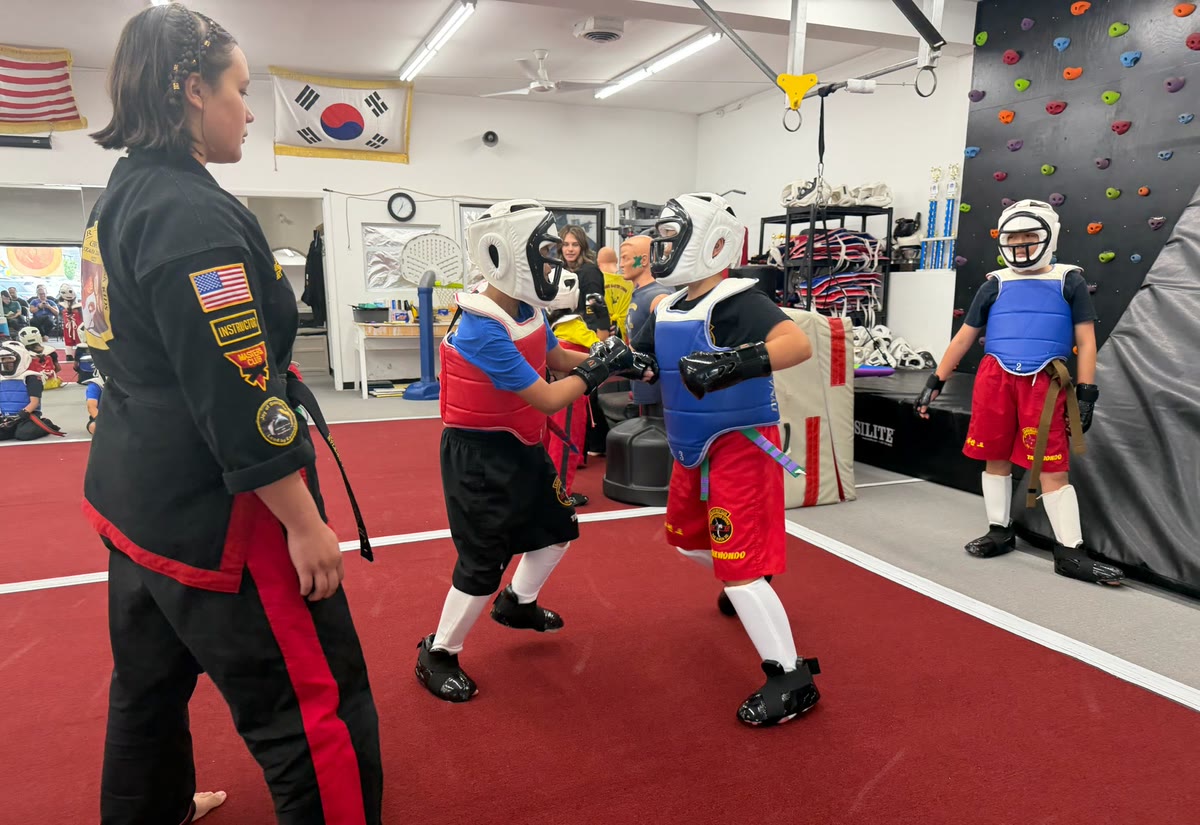
A Tae Kwon Do tournament for kids is a day of competition where children perform forms, spar and sometimes break boards in front of judges, in divisions by age and belt rank, so each child competes against children at a similar level. A first tournament goes best when a child knows their form well, can spar with control in class, wants to go, and has an instructor who agrees they are ready.
Chung TKD in New Hyde Park teaches Tae Kwon Do to children ages 2 to 13, in three programs by age: Pee-Wee, Children and Youth. Grandmaster Howard Chung, 9th Dan, has taught Tae Kwon Do since 1970 and opened the school in 1984. The school holds in-house tournaments for its students twice a year. This guide is by Master Chris J. Chung, 5th-degree black belt.
What happens at a Tae Kwon Do tournament?
A tournament is a series of events, and a child can enter one or several. Tae Kwon Do competitions typically include sparring, breaking and forms, Wikipedia's Taekwondo entry notes, and some tournaments add demonstration teams and self-defense. Olympic Tae Kwon Do is sparring only, so a local tournament offers more events than the Olympics do.
Which events can a child enter?
A child can enter forms, sparring, breaking, or any mix the tournament offers.
- Forms. A child performs a set pattern of blocks, punches and kicks alone, and judges score its accuracy and presentation. ITF schools call forms hyung or tul, and World Taekwondo schools call them poomsae.
- Sparring. Two children of similar age, rank and weight face each other in a short match, in protective gear. They score points for controlled punches and kicks to the allowed targets, and a referee stops the match for anything unsafe.
- Breaking. A child breaks boards with a kick or a strike in front of judges. Our guide to why Tae Kwon Do students break boards has more on breaking.
At Chung TKD, color belts learn the ITF forms, called hyung, and black belts learn the forms Kwang-Gae and Koryo.
How are kids grouped into divisions?
Children compete in divisions by age and belt rank, and sparring divisions add weight, so a child faces opponents of a similar size and experience. At the top level, competitors are matched within gender and weight division, Wikipedia's Taekwondo entry notes. Each tournament sets its own groups and lists them on its registration form. When only a few children sign up for a division, the organizer may combine it with the next age or belt group. Our guide to the belt colors in order has the full list.
What is the difference between ITF and Olympic-style sparring?
The two main rule sets differ in contact and scoring. ITF sparring uses a continuous point system and is not full contact. World Taekwondo sparring, the Olympic style, scores kicks to a padded chest protector, and major tournaments score it electronically, as Wikipedia's Taekwondo entry describes. In World Taekwondo scoring, a kick to the head or a turning kick earns more points than a punch. Each tournament's rules say whether head contact is allowed in each age group, so read them before your child spars.
What sparring gear does a child need?
The gear depends on the style, and each tournament lists the gear it requires. ITF Tae Kwon Do usually pads only the hands and feet, while World Taekwondo, the Olympic style, adds a head guard, a chest protector, forearm and shin guards, a mouthpiece and a groin cup, as Wikipedia's Taekwondo entry describes. Some tournaments require a certain type or color, so check the list before you buy anything. Have your child practice in the full set before the day, since new gear feels bulky at first. Label every piece, because many bags look alike.
What is tournament day like?
Expect a long day with a lot of waiting. Children check in, warm up, and then wait until their division is called, and some tournaments weigh sparring competitors at check-in. Each division competes in its own ring with its own judges. Children wait with their school's instructors or the ring staff, and parents watch from the stands.
Pack the night before:
- The uniform and belt.
- Sparring gear, with every piece labeled, if your child spars.
- Water and simple snacks.
- Something quiet to do during the wait.
- The registration confirmation and any forms the tournament asks for.
How can parents help at a tournament?
Cheer for effort and good sportsmanship, and leave the coaching to the instructor. A bow and a handshake after every match, win or lose, is part of the sport. On the drive home, ask what your child's favorite part was, the question our guide to a first Tae Kwon Do class suggests.
Is my child ready for a first tournament?
A child is ready when they know their form start to finish without help, can spar with control in class, and want to go. Ask your child's instructor first, since the instructor sees how your child handles pressure in class. An in-house tournament at your child's school, if it holds one, is a smaller first step than a large open tournament. Running the form at home helps too, and our guide to practicing Tae Kwon Do at home has ideas.
What should you ask before your child's first tournament?
Ask your child's instructor these questions, or find the answers in the tournament's registration packet, before you sign up.
- Which events should my child enter, and is one event enough for a first time?
- Which form will my child perform, and do they know it well enough to perform it alone?
- Which rules does the sparring follow, and is head contact allowed in my child's age group?
- What gear does the tournament require, and does it set a type or color?
- How are the divisions grouped, and is there a weigh-in?
- When should we arrive to check in, and when is my child's division likely to compete?
- Who stays with my child at the ring, and where do parents sit?
- Are photos and video allowed?
How do tournaments work at Chung TKD?
Chung TKD holds in-house tournaments for its students twice a year. They have forms, sparring and breaking, the divisions are kept small, and families watch. The awards are usually gold medals and grand champion trophies. A one-day Tournament Intensive, held now and then, helps students get ready for the tournaments. The Competition Team trains invited students to compete in tournament divisions. The classes page describes the Competition Team and the school's other programs.
Trying Tae Kwon Do at Chung TKD
Every new family starts with two free trial classes, and a parent or guardian stays for them. Children wear something comfortable, sweats or shorts, and the uniform comes when a family signs up.
Questions parents ask
Do tournaments decide a child's belt?
No. A child earns the next belt at a belt test. At Chung TKD, a child below brown belt tests when the instructors judge them ready, Grandmaster Chung runs the test, and the instructors demonstrate.
How old does a child need to be for a first tournament?
There is no single age, and many tournaments run divisions for young children. A child who knows a form and can follow a referee's commands is ready to try.
What is the difference between forms and sparring?
Forms are a set pattern a child performs alone for judges, and sparring is a match against another child in protective gear.
What do kids win at a Tae Kwon Do tournament?
At Chung TKD's in-house tournaments, the awards are usually gold medals and grand champion trophies. At open tournaments, children who place in their division usually receive a medal or a trophy, and some give every child a medal for taking part.
Can parents watch a Tae Kwon Do tournament?
Yes. Families watch Chung TKD's in-house tournaments. At open tournaments, parents watch from the stands while children wait with their instructors, and some charge spectators an admission fee, so check the registration packet.