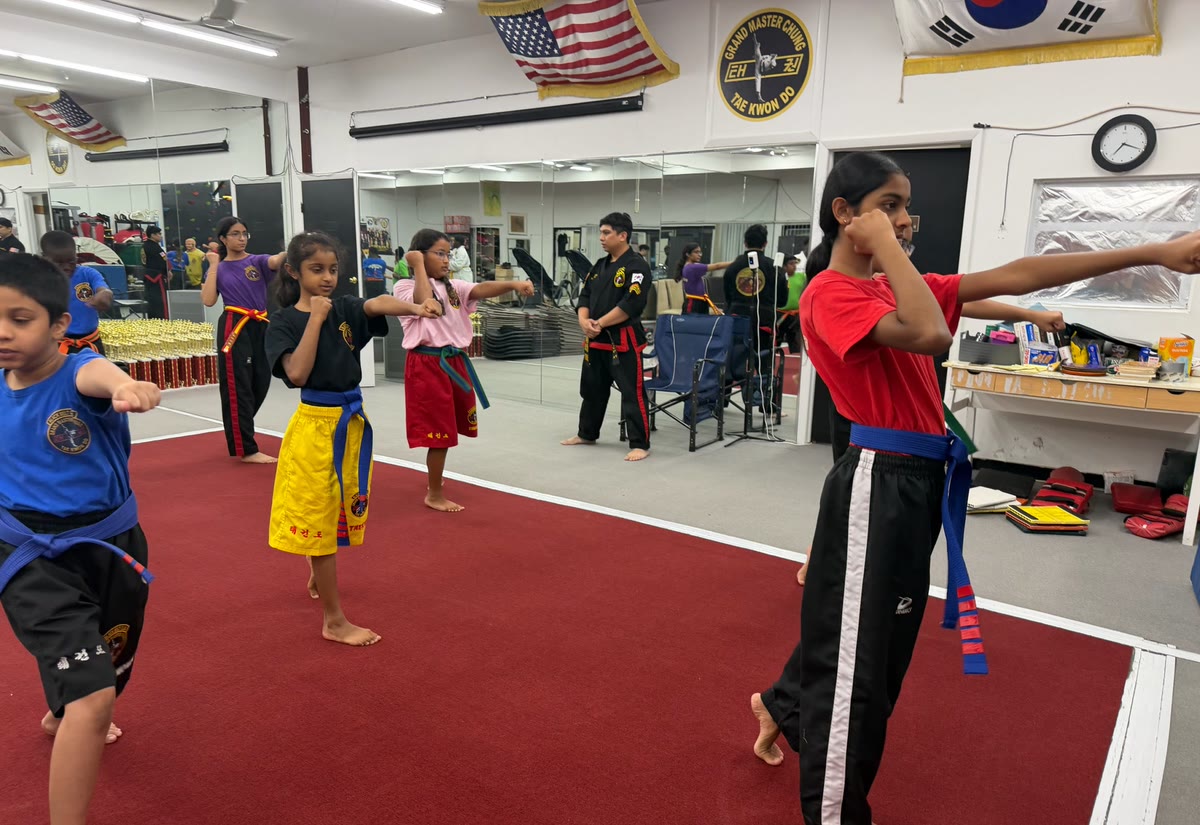
Tae Kwon Do is a Korean martial art and Olympic sport known for its high, jumping and spinning kicks. Hapkido, also Korean, is a self-defense art that mixes kicks and strikes with joint locks and throws.
Chung TKD in New Hyde Park teaches Tae Kwon Do, not Hapkido, to children ages 2 to 13. Grandmaster Howard Chung, 9th Dan, has taught Tae Kwon Do since 1970 and opened the school in 1984. This guide is by Master Chris J. Chung, 5th-degree black belt.
How do Tae Kwon Do and Hapkido compare for kids?
The biggest difference for a child is that Hapkido uses joint locks and throws at close range, while Tae Kwon Do puts its weight on kicks and punches. The general facts here come from Wikipedia's entries on Taekwondo and Hapkido.
| Tae Kwon Do | Hapkido | |
|---|---|---|
| Origin | Korean. Tae Kwon Do got its name after the Korean War. | Korean. Hapkido was adapted from a Japanese form of jujutsu brought to Korea after World War II, and its teachers added kicks and strikes from Korean arts. |
| Age to start | At Chung TKD, Tae Kwon Do starts at 2, in the Pee-Wee program, and children ages 4 to 6 are in the Children program. | Ask a school what age it starts children. |
| What each art teaches | Kicks, punches and blocks, and it is known above all for its kicks. | Kicks, punches and blocks, plus joint locks and throws. |
| Throws and joint locks | A typical curriculum can include some throwing and falling techniques. | Hapkido is well known for its wristlocks and teaches break falling, which is practice in how to fall. |
| Sparring and contact | Olympic sparring is full contact, and point sparring is light contact. | Sparring is part of training, but the art puts self-defense ahead of sport fighting. |
| Belts | Colored belts, then black belt degrees. | Colored belts, then black belt degrees, at levels essentially the same as those of other Korean arts, such as Tae Kwon Do. Students also learn weapons as they move up. |
Our guide to Tae Kwon Do sparring for kids explains how children build up to sparring.
At Chung TKD, color belts learn ITF forms, which the school calls hyung, and Kwang-Gae and Koryo are the black belt forms. A form is a set sequence of moves. Self-defense is part of class.
What is Hapkido?
Hapkido is a Korean martial art of self-defense that uses joint locks, throws, kicks, punches and other strikes, and it also teaches traditional weapons. Its name is most often translated as the way of coordinating energy. The art stresses circular motion, redirecting an attacker's force and control of the other person, and it relies on footwork and leverage rather than strength against strength. Its training is vigorous and demanding, but strength is not a requirement, because the strength the techniques need develops with training. Tae Kwon Do's name, by contrast, describes its techniques. Tae means to strike with the foot, kwon to strike with the hand, and do the way.
How are the kicks different?
Both arts kick, but each favors different kicks. Tae Kwon Do is known for head-height, jumping and spinning kicks and for fast kicking, and Olympic sparring awards extra points for spinning kicks and kicks to the head. Hapkido has a wide variety of kicks, many of them like Tae Kwon Do kicks but with more weight on circular motion, and most Hapkido styles include high and jumping kicks too. Unlike most modern Tae Kwon Do styles, Hapkido also uses many low kicks below the waist, and hooking and sweeping kicks, such as a low spinning heel kick.
Hapkido's teachers took kicks and strikes from Korean arts such as Taekkyeon and Tang Soo Do. Our guide to Tae Kwon Do vs Tang Soo Do for kids explains how Tang Soo Do and Tae Kwon Do are related.
How do Tae Kwon Do and Hapkido teach self-defense?
Hapkido puts self-defense first, while Tae Kwon Do teaches self-defense as one part of a typical curriculum, beside forms, sparring and board breaking. Hapkido works at long range with kicks and strikes and at close range with joint locks and throws. Our page on self-defense for kids explains how self-defense fits into Tae Kwon Do class at Chung TKD.
What happens in a typical class of each art?
A typical Hapkido class mixes strikes with throws, joint locks and break falling, while a typical Tae Kwon Do class works mostly on kicks, punches, blocks and forms. Wikipedia's entries list what a typical class or curriculum includes, and schools vary.
- A typical Hapkido class. Practice of strikes, defensive throws and grappling, break falling, sparring, and meditation and exercises to build internal energy.
- A typical Tae Kwon Do class. Forms, sparring, board breaking, self-defense techniques, some throwing and falling, stretching and workouts, meditation and breathing control, a focus on discipline, respect and self-confidence, and tests to move up in rank.
How do you choose between Tae Kwon Do and Hapkido for your child?
Start with what your child enjoys, then let a first class tell you more.
- A child who loves to kick, jump and spin may take to Tae Kwon Do, the art known for those kicks.
- A child who likes to grab and hold may enjoy Hapkido's joint locks and throws, and may also like jiu-jitsu, which our guide to Tae Kwon Do vs jiu-jitsu for kids covers.
The instructor and the class matter as much as the name of the art. Our guide to which martial art is best for kids compares Tae Kwon Do with karate, judo, Brazilian jiu-jitsu and kung fu, and our guide to the Korean martial arts covers Hapkido, Tang Soo Do and the other arts from Korea.
Trying Tae Kwon Do at Chung TKD
Chung TKD has three programs by age. Pee-Wee is for ages 2 to 3, Children is for ages 4 to 6 and Youth is for ages 7 to 13. New families start with two free trial classes, and a parent or guardian stays for both. Kids wear something comfortable, sweats or shorts, and the uniform comes if they sign up.
Grandmaster Chung runs every belt test, and twice a year the school holds in-house tournaments with forms, sparring and board breaking, which families watch.
Looking for Tae Kwon Do classes for kids near New Hyde Park? Chung TKD is at 1527 Jericho Turnpike, New Hyde Park, NY 11040. Book a free class online.
Questions parents ask
Is Hapkido an Olympic sport?
No. Tae Kwon Do is an Olympic sport, and Hapkido is not. Hapkido puts self-defense ahead of sport fighting.
Is Hapkido the same as Aikido?
No. Both grew from the same Japanese form of jujutsu, and their names share some Chinese characters, but they became separate arts. They differ in philosophy, in their range of responses and in how techniques are done. Hapkido's wide variety of kicks also makes it distinctly Korean.
Does Hapkido use weapons?
Yes. As students move up in rank, Hapkido teaches traditional weapons, such as a short stick, a cane and a rope. Tae Kwon Do is mainly an unarmed art, though individual schools often add some weapons training.
Do Hapkido and Tae Kwon Do share any techniques?
Yes, especially kicks. Hapkido took kicks and strikes from Korean arts such as Taekkyeon and Tang Soo Do, and many of its kicks look like Tae Kwon Do kicks.
Does Chung TKD teach Hapkido?
No. Chung TKD teaches Tae Kwon Do to children ages 2 to 13 in New Hyde Park, and new families start with two free trial classes.