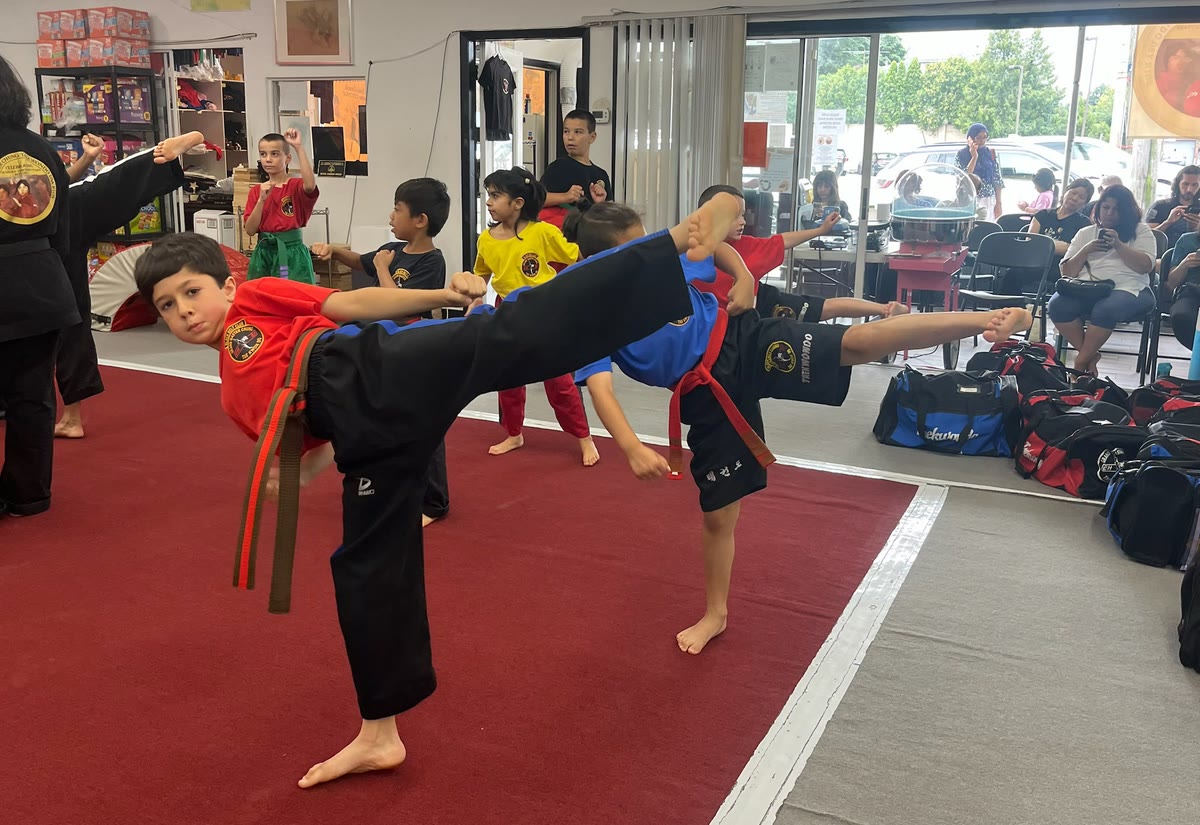
Five basic Tae Kwon Do kicks are the front kick, the side kick, the roundhouse kick, the back kick and the axe kick. In Korean they are ap chagi, yeop chagi, dollyeo chagi, dwi chagi and naeryeo chagi, and chagi means kick. Each one moves the leg a different way, and a child learns them in class, under an instructor.
Chung TKD in New Hyde Park teaches Tae Kwon Do, a Korean martial art also written taekwondo, to children ages 2 to 13, in three programs by age: Pee-Wee, Children and Youth. Grandmaster Howard Chung, 9th Dan, has taught Tae Kwon Do since 1970 and opened the school in 1984. This guide is by Master Chris J. Chung, 5th-degree black belt.
How can I tell the five kicks apart?
Watch which way the leg goes. Here is the one thing to look for in each kick.
- Front kick. The knee comes up in front, and the foot snaps straight ahead.
- Side kick. The body turns sideways, and the leg drives straight out to the side.
- Roundhouse kick. The standing foot turns, and the leg swings around in an arc.
- Back kick. The kicker turns away, looks over the shoulder and pushes the leg straight back.
- Axe kick. The leg rises high, then drops straight down, heel first.
What does chagi mean?
Chagi is the Korean word for kick, and the word in front of it names the kick, so ap chagi is the front kick, yeop chagi the side kick and dwi chagi the back kick. These spellings follow Wikipedia's Taekwondo and Axe kick entries, and other schools may write them differently.
What is a front kick?
A front kick, ap chagi, is a kick straight ahead. The knee lifts in front of the body, then the leg straightens and the foot snaps out at the target. It lands with the ball of the foot, with the toes pulled back, and it is also called a snap kick, as Wikipedia's Front kick entry explains.
What is a side kick?
A side kick, yeop chagi, drives the leg straight out to the side. The knee lifts as the body turns sideways, then the leg extends. It lands with the outside edge of the foot or with the heel, as Wikipedia's list of taekwondo techniques explains.
What is a roundhouse kick?
A roundhouse kick, dollyeo chagi, swings the leg around in an arc. The knee lifts, the hips turn and the standing foot pivots, then the leg snaps into the target from the side. It lands with the top of the foot, called the instep, or with the ball of the foot, and it is also called a turning kick.
What is a back kick?
A back kick, dwi chagi, pushes the leg straight back. The kicker turns away from the target, looks over the shoulder and drives the back leg at it. It lands with the heel.
What is an axe kick?
An axe kick, naeryeo chagi, comes down from above. The leg rises high in an arc, then drops with the heel pointed down, like the blade of an axe. It lands with the heel, and because the leg rises so high, it takes a lot of flexibility.
What are jumping and spinning kicks?
They are the basic kicks done in the air or with a turn. Any of these kicks can be done as a jumping kick, a spinning kick or both, and with the front leg or the back leg, as the same list explains.
Why is Tae Kwon Do known for its kicks?
Because kicking comes first in the art. Wikipedia's Taekwondo entry describes the art by its head-height kicks, its jumping and spinning kicks, and its fast kicking. The name points the same way, since tae means to strike with the foot, kwon to strike with the hand, and do the way. Our guide to Tae Kwon Do vs karate compares the two arts.
How does my child learn the kicks?
In class, under an instructor. At Chung TKD, the school's instructors teach the classes, and classes also cover the ITF forms, called hyung, and self-defense. Ask an instructor after class which kicks your child is working on.
Can my child practice kicks at home?
Yes, once an instructor has shown them the kick in class. Our guide to practicing Tae Kwon Do at home covers what to practice between classes and how to keep it safe.
Where else do kicks show up?
In forms, sparring and breaking, the three events at the school's in-house tournaments, where families watch. Our guide to why students break boards explains what a board shows about a kick, and our guide to whether parents can watch a class covers regular classes.
Where is Chung TKD?
Chung TKD is at 1527 Jericho Turnpike, New Hyde Park, NY 11040.
How do we get started?
Start with the two free trial classes. A parent or guardian stays for both, and kids wear something comfortable, sweats or shorts. Book a free class online, and our guide to a first Tae Kwon Do class covers the first visit.
Questions parents ask
What are the basic kicks in Tae Kwon Do?
Five basic kicks are the front kick, the side kick, the roundhouse kick, the back kick and the axe kick.
What are the Tae Kwon Do kicks called in Korean?
Ap chagi is the front kick, yeop chagi the side kick, dollyeo chagi the roundhouse kick, dwi chagi the back kick and naeryeo chagi the axe kick. Chagi means kick.
Which part of the foot lands in each kick?
The ball of the foot in a front kick, the outside edge of the foot or the heel in a side kick, the top or the ball of the foot in a roundhouse kick, and the heel in a back kick and an axe kick.
Should my child practice kicks without an instructor?
Learn each kick in class under an instructor first, then practice it at home.
How does a new family start at Chung TKD?
With two free trial classes. A parent or guardian stays for both.