Tae Kwon Do and Tang Soo Do are Korean martial arts with shared roots, because Tang Soo Do, an art based on karate and Chinese arts, became the basis for Tae Kwon Do in the mid-1950s. Tae Kwon Do is known for its high, jumping and spinning kicks, and its World Taekwondo style is an Olympic sport, while Tang Soo Do keeps forms taken mainly from karate and spars for points, where a hand strike usually scores the same as a kick.
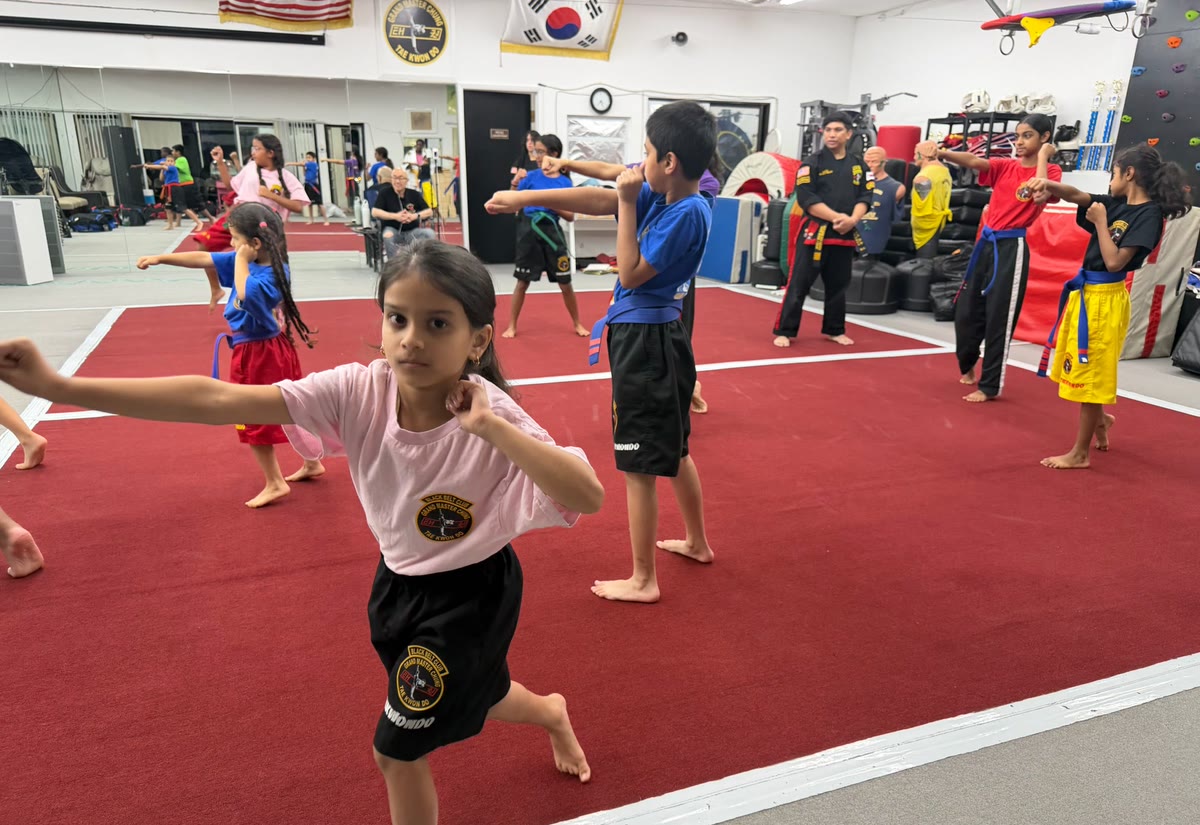
Chung TKD in New Hyde Park teaches Tae Kwon Do, not Tang Soo Do, to children ages 2 to 13. Grandmaster Howard Chung, 9th Dan, has taught Tae Kwon Do since 1970 and opened the school in 1984. This guide is by Master Chris J. Chung, 5th-degree black belt.
How do Tae Kwon Do and Tang Soo Do compare for kids?
The biggest differences for a child are in the kicks, the forms and the sparring rules. The general facts here come from Wikipedia's entries on Taekwondo, Tang Soo Do and Korean forms.
- Origin. Tae Kwon Do is Korean. Its name was introduced in the mid-1950s, and by the end of that decade the Korean schools of martial arts, called kwans, had agreed on it as their common name. Its World Taekwondo style is an Olympic medal sport. Tang Soo Do is Korean too. Its first schools opened at the end of Japanese rule, teaching an art drawn from Okinawan karate and kung fu.
- Age to start. At Chung TKD, Tae Kwon Do starts at 2, in the Pee-Wee class. For Tang Soo Do, ask a school what age it starts children.
- What kids learn. Both arts teach kicks, punches, blocks and forms. Tae Kwon Do puts its emphasis on kicks, including head-height, jumping and spinning kicks. Tang Soo Do pairs straight punches with circular blocks.
- Forms. In both arts, a form, a set pattern of moves practiced alone, can be called a hyung. Tae Kwon Do built forms of its own to replace the karate forms, and Tang Soo Do's forms are taken mainly from karate.
- Sparring and contact. World Taekwondo sparring, the Olympic style, is full contact. ITF Tae Kwon Do sparring is not full contact. Tang Soo Do spars in point matches, without full contact to the head.
- Belts. Both arts climb through colored belts, called gup grades, to black belt degrees, called dan. In Tang Soo Do, the dan belt is often midnight blue instead of black.
At Chung TKD, color belts learn the ITF forms, called hyung, and Kwang-Gae and Koryo are the black belt forms. The school does not teach the eight color belt forms of the Kukkiwon style, which World Taekwondo follows. Self-defense is part of class.
Is Tang Soo Do the same as Tae Kwon Do?
No, not today. They are two arts with one history. Tang Soo Do became the basis for Tae Kwon Do in the mid-1950s, when the Korean kwans united, and Wikipedia's Taekwondo entry says traditional Tae Kwon Do is still practiced, generally under names such as Tang Soo Do. Each art has its own forms, sparring rules and belt customs.
Is Tang Soo Do a kind of karate?
Tang Soo Do grew from karate, but it is a Korean art with Chinese roots too. Its name means the way of the Tang hand, and Wikipedia's Tang Soo Do entry says the same characters are read karate-do in Japanese, the way karate itself was once written. Its influences are Okinawan karate and two Chinese arts, Taijiquan and Shaolin Long Fist. Tae Kwon Do, also written taekwondo, joins three words: tae (strike with the foot), kwon (strike with the hand) and do (the way). Some of its founders had studied karate too, and they built forms of their own. If you are also weighing karate itself, read our guide to Tae Kwon Do vs karate.
How are the forms different?
Each art teaches its own set of forms, so a child learns different patterns in each. Tang Soo Do's forms are taken mainly from Japanese karate kata, among them the Pyung Ahn forms and Bassai. Tae Kwon Do's forms differ by style. ITF schools usually call their forms tul, and the ITF set, called Chang Hon, has 24 of them. Schools of the Kukkiwon style, which World Taekwondo follows, call theirs poomsae, and color belts learn a set of eight. Our guide to Tae Kwon Do forms explains which forms a child learns at Chung TKD and how they fit into stripes and belts.
How is sparring different for kids?
The rules differ by art and by style, and Tang Soo Do's rules also vary from one association to another. In World Taekwondo, the Olympic style, sparring is full contact with continuous scoring, and players at major events wear electronic body protectors. In ITF sparring, contact is not full, and players wear pads on their hands and feet. Kicks to the head score in both styles. Tang Soo Do spars in point matches. Many of the rear-leg and spinning kicks seen in ITF and World Taekwondo matches are common in Tang Soo Do competition too, but they are not delivered with full contact to the head.
Our guide to Tae Kwon Do sparring for kids explains how children build up to sparring and what gear they wear. Chung TKD holds in-house tournaments twice a year, with forms, sparring and breaking, and families watch.
How can you tell which art a class teaches?
You can check these five things in one visit or one phone call. Together they usually tell you which art, and which style, a class teaches.
- The name. Ask which art the school teaches, by name. Korean karate is an older name that can mean either art, as our guide to the Korean martial arts explains.
- The forms. Ask the names of the forms a color belt learns. Chon-Ji and the rest of the Chang Hon set point to ITF Tae Kwon Do, and eight forms numbered Il Jang to Pal Jang point to Kukkiwon-style Tae Kwon Do. Pyung Ahn and Bassai, forms taken from karate, point to Tang Soo Do or to traditional Tae Kwon Do, which uses the Pyung Ahn forms too.
- The top belt. A midnight blue belt for the dan ranks points to Tang Soo Do.
- The sparring. Ask what gear children wear to spar. A chest protector, called a hogu, is part of World Taekwondo sparring, the Olympic style, which is full contact. ITF Tae Kwon Do spars in hand and foot pads, without a hogu and without full contact. Tang Soo Do spars in point matches, without full contact to the head.
- The kicks. A class built around head-height, jumping and spinning kicks is typical of Tae Kwon Do, though Tang Soo Do competitions use many of the same kicks.
At Chung TKD, the art is Tae Kwon Do, the forms are the ITF hyung with Kwang-Gae and Koryo for black belts, and the top belt is black, not midnight blue. A child below brown belt tests for the next belt when the instructors say they are ready, and from brown belt on, belt tests are on set dates. Grandmaster Chung runs every belt test.
How do you choose between Tae Kwon Do and Tang Soo Do for your child?
Start with what your child loves to do, then let a first class tell you more.
- A child who is always kicking, jumping and spinning may take to Tae Kwon Do, the art known for those kicks.
- A child who likes to punch as much as kick may enjoy Tang Soo Do's sparring, where a hand strike usually scores the same as a kick. Tae Kwon Do teaches punches and blocks too.
The instructor and the class matter as much as the name of the art. If your child comes home asking to go back, that tells you a lot. Our guide to which martial art is best for kids compares Tae Kwon Do with karate, judo, Brazilian jiu-jitsu and kung fu. If you are also looking at Hapkido, the Korean self-defense art that mixes kicks and strikes with joint locks and throws, read our guide to Tae Kwon Do vs Hapkido for kids.
Trying Tae Kwon Do at Chung TKD
Chung TKD has three programs by age. Pee-Wee is for ages 2 to 3, Children is for ages 4 to 6 and Youth is for ages 7 to 13. New families start with two free trial classes, and a parent or guardian stays for both. Kids wear something comfortable, sweats or shorts, and the uniform comes if they sign up.
Looking for Tae Kwon Do classes for kids near New Hyde Park? Chung TKD is at 1527 Jericho Turnpike, New Hyde Park, NY 11040. Book a free class online.
Questions parents ask
Is Tang Soo Do older than Tae Kwon Do?
As a name, yes. Tang Soo Do's first schools opened at the end of Japanese rule in Korea, about a decade before the name Tae Kwon Do was introduced in the mid-1950s. By the end of that decade, the original Korean schools, some of which had called their art Tang Soo Do, had agreed on Tae Kwon Do as their common name.
Why is a Tang Soo Do black belt often blue?
In Tang Soo Do, a dan rank is often shown by a midnight blue belt instead of black. Wikipedia's Tang Soo Do entry explains that in Korean culture black stands for perfection, and since no one is perfect, the dan belt is midnight blue.
Is Tang Soo Do an Olympic sport?
No. Tae Kwon Do is the Olympic sport, in its World Taekwondo style.
Can a child switch from Tang Soo Do to Tae Kwon Do?
Yes. Both arts teach kicks, punches and blocks, so those carry over, and the child learns a new set of forms. If your child holds a Tang Soo Do belt, ask where they would start when you book a free class.
Does Chung TKD teach Tang Soo Do?
No. Chung TKD teaches Tae Kwon Do to children ages 2 to 13 in New Hyde Park, and new families start with two free trial classes.