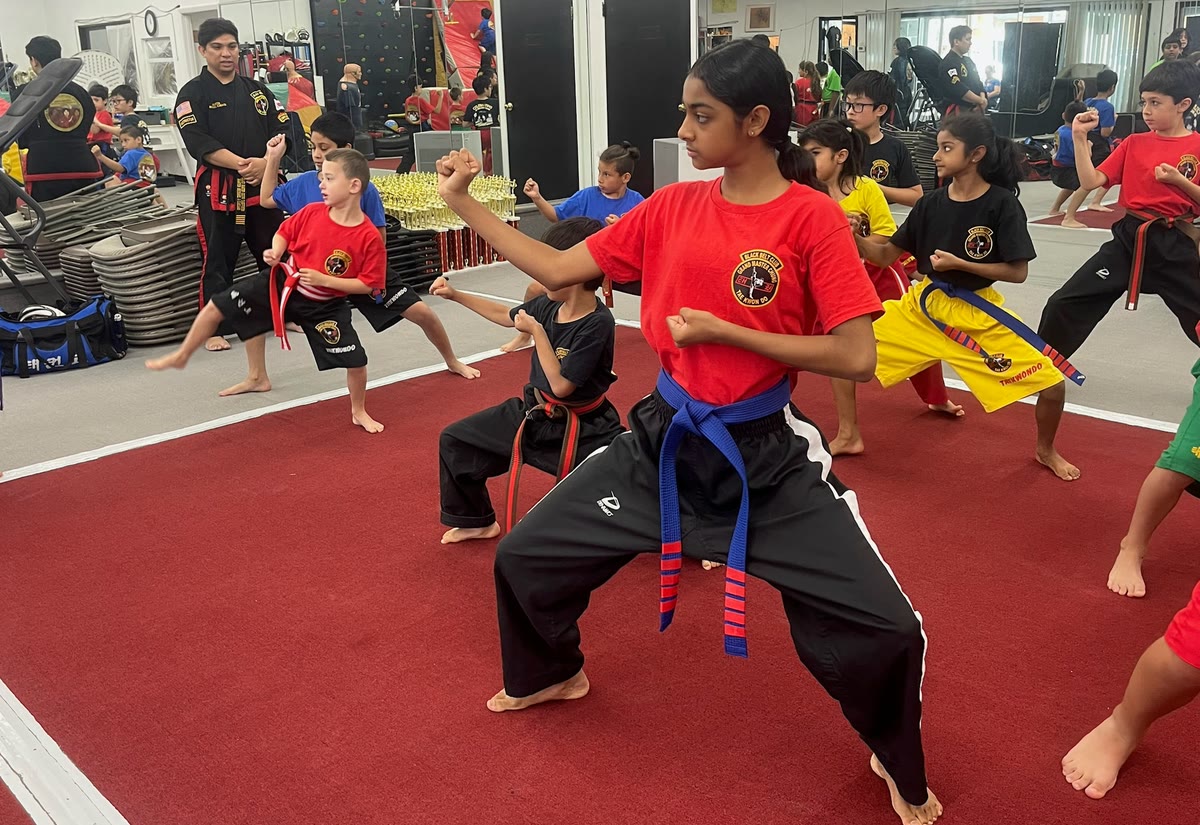
A horse stance is a wide, low stance with the feet far apart and pointing straight ahead, the knees bent and the back straight, as if the student were sitting on a horse. In Tae Kwon Do it is also called the sitting stance or the horse riding stance, and students use it to practice punches. A child learns it and the other basic stances in class, under an instructor.
Chung TKD in New Hyde Park teaches Tae Kwon Do, a Korean martial art also written taekwondo, to children ages 2 to 13, in three programs by age: Pee-Wee, Children and Youth. Grandmaster Howard Chung, 9th Dan, has taught Tae Kwon Do since 1970 and opened the school in 1984. This guide is by Master Chris J. Chung, 5th-degree black belt.
What is a horse stance in Tae Kwon Do?
A low stance with the feet wide apart and the knees bent, as in a squat. Wikipedia's Taekwondo stances entry lists it as the sitting stance, also called the horse riding stance or the middle stance. The feet face forward, and the back stays straight as the hips lower toward the floor, with the shins upright. Our parent's glossary covers the Korean words used in Tae Kwon Do.
How do you do a horse stance, step by step?
Here are the five steps, starting from standing.
- Stand up straight with the feet together.
- Step one foot out to the side, so the feet are far apart. The width varies from school to school, and an instructor shows your child how wide.
- Point both feet straight ahead, so they are parallel to each other.
- Bend the knees and lower the hips, as if sitting down, until the shins are upright.
- Keep the back straight and the chest facing forward, so the upper body does not lean.
To come out of the stance, straighten the legs and step the feet back together.
What should I look for in my child's horse stance?
Look from the floor up. A good horse stance shows these five things.
- The feet point straight ahead, parallel to each other.
- The feet stand far apart, wider than the shoulders.
- The shins stand upright, straight up from the floor.
- The knees bend, and the hips sit low between the feet.
- The back stays straight, and the upper body does not lean forward.
Praise a steady stance, not how low it goes. If something looks off, ask an instructor after class rather than correcting it at home.
Why do Tae Kwon Do students practice the horse stance?
To practice punches and to strengthen the legs and back. Wikipedia's Horse stance entry says these are its most common uses. The Taekwondo stances entry calls stances critical for balance, precision and good technique.
What are the basic Tae Kwon Do stances?
Here are seven common stances, as the Taekwondo stances entry describes them, with the one thing to look for to tell each apart.
- Attention stance. The feet are together, the legs straight and the arms straight at the sides.
- Ready stance. The feet are shoulder width apart, the legs straight and the fists held in front of the body.
- Horse stance, or sitting stance. The feet are far apart and side by side, with both knees bent.
- Front stance. One foot is well in front of the other, with the front knee bent and the back leg straight.
- Back stance, or L-stance. One foot is in front of the other, the back foot turns sideways, and most of the weight sits on the back leg.
- Rear foot stance, also called the cat stance or the tiger stance. The feet are close together, both knees bend, and the front foot rests on its toes.
- Fighting stance. The body turns to the side, the knees bend slightly, and the hands are up to protect the head.
What are the attention and ready stances?
They are the stances for bowing and for starting a form. In the attention stance, the legs are straight and together and the arms are held straight at the sides, and every bow starts from it. In the ready stance, the feet are shoulder width apart with the toes pointing forward, and the fists are held in front of the body with the elbows slightly bent. Many forms start and end in the ready stance.
What is a front stance?
A wide, deep stance with one foot in front of the other and the hips facing forward. The front knee bends and the back leg stays straight. The feet are apart from side to side as well as front to back, and the stance is firm and steady.
What is a back stance, or L-stance?
A stance with most of the weight on the back leg. One foot is in front of the other, the front foot points straight ahead, and the back foot turns 90 degrees, so the feet make an L shape.
What is a cat stance?
A short stance with the legs bent and close together, also called the rear foot stance or the tiger stance. The back foot turns sideways, and the front foot points straight ahead, resting on its toes.
What is a fighting stance?
The stance for sparring. The body turns to the side to show a smaller target, the knees bend slightly for balance, the feet stand about two shoulder widths apart, and the hands are up, protecting the head. In an art that kicks a lot, like Tae Kwon Do, the weight usually shifts slightly to the back leg so the front leg can lift quickly, as the Taekwondo stances entry explains.
Do all Tae Kwon Do schools use the same stances?
Mostly, but the names and details vary. The Taekwondo stances entry notes that the two main federations, World Taekwondo and the International Taekwondo Federation, or ITF, teach some stances differently, and that individual schools vary a little too. In the attention stance, for example, the feet turn out at a 45-degree angle in ITF style and point straight ahead in World Taekwondo style. ITF Tae Kwon Do also has stances of its own, such as the closed stance, with the feet together, and the fixed stance, a longer L-stance with the weight split evenly. Chung TKD teaches the ITF forms, called hyung, so ask an instructor what the school calls each stance.
Is the horse stance the same in karate and kung fu?
Close, with small differences from art to art and school to school. In karate the horse stance is called kiba-dachi, and the Horse stance entry says the feet always stay parallel, while the width and the height vary between schools. In Chinese martial arts it is called ma bu, and many northern styles hold it with the thighs parallel to the floor. Our guides to Tae Kwon Do vs karate and Tae Kwon Do vs kung fu for kids compare the arts.
Can my child practice stances at home?
Yes, once an instructor has shown them the stance in class. A stance needs only a clear spot on the floor, and bare feet grip better than socks on a smooth floor. Ask an instructor how long your child should hold each stance. Our guide to practicing Tae Kwon Do at home covers what else to practice between classes.
How does my child learn the stances?
In class, under an instructor. At Chung TKD, the school's instructors teach the classes, and classes also cover the ITF forms, called hyung, and self-defense. Ask an instructor after class which stances your child is working on.
Where else do stances show up?
In forms and in sparring. The Taekwondo stances entry says stances are seen most in forms competition, and forms are one of the three events at the school's in-house tournaments, with sparring and breaking, where families watch. In sparring, students move from a fighting stance. Our guides to kids' Tae Kwon Do tournaments and Tae Kwon Do sparring for kids explain both, and our guide to whether parents can watch a class covers watching from the side of the mat.
Where is Chung TKD?
Chung TKD is at 1527 Jericho Turnpike, New Hyde Park, NY 11040.
How do we get started?
Start with the two free trial classes. A parent or guardian stays for both, and kids wear something comfortable, sweats or shorts. Book a free class online, and our guide to a first Tae Kwon Do class covers the first visit.
Questions parents ask
What is a horse stance?
A wide, low stance with the feet far apart and pointing straight ahead, the knees bent and the back straight. In Tae Kwon Do it is also called the sitting stance or the horse riding stance.
What are the basic stances in Tae Kwon Do?
The attention stance, the ready stance, the horse or sitting stance, the front stance, the back stance or L-stance, the cat stance and the fighting stance.
What is the horse stance used for?
Practicing punches and strengthening the legs and back.
What is the horse stance called in karate?
Kiba-dachi. The feet stay parallel, as they do in the Tae Kwon Do horse stance.
Can my child practice stances at home?
Yes, once an instructor has shown them the stance in class. A clear spot on the floor is enough, and bare feet grip better than socks on a smooth floor.
How does a new family start at Chung TKD?
With two free trial classes. A parent or guardian stays for both.