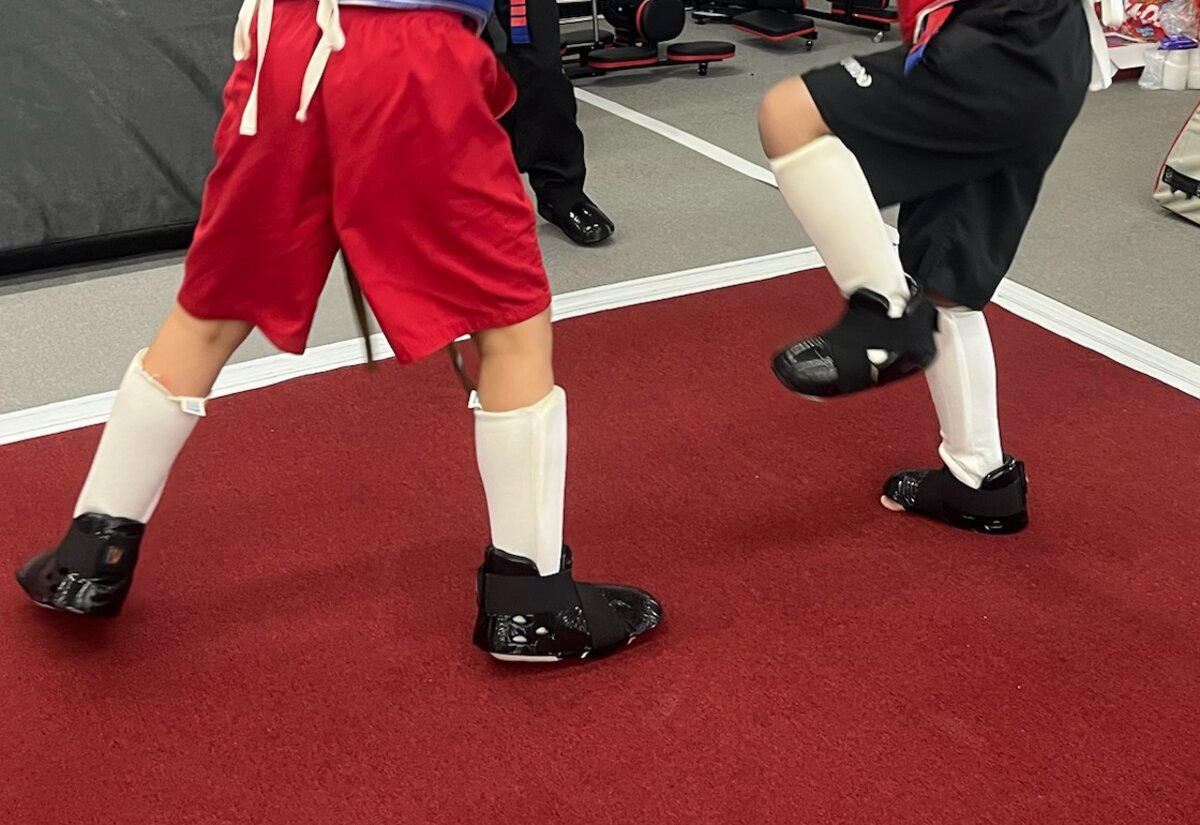
Tae Kwon Do is a Korean striking art, where children learn kicks, punches, blocks and forms while standing. Brazilian jiu-jitsu is a grappling art, where children learn to hold, pin and escape, mostly on the mat with a partner. Neither is better for every child, so the right one depends on how your child likes to move and what you want them to learn.
Chung TKD in New Hyde Park teaches Tae Kwon Do to children from 2 to 13. Grandmaster Howard Chung, 9th Dan, leads the school. He has taught Tae Kwon Do since 1970 and opened the school in 1984. This guide, by Master Chris J. Chung, 5th-degree black belt, compares the two arts, not schools.
What's the difference between Tae Kwon Do and jiu-jitsu?
Tae Kwon Do keeps an opponent at a distance with kicks and strikes, and jiu-jitsu closes the distance to control an opponent with holds. Tae Kwon Do, also written taekwondo, is best known for its kicks. Brazilian jiu-jitsu, often called BJJ, grew in Brazil out of Japanese judo and jujutsu. Sport jiu-jitsu has no kicks or punches. Students take a partner to the ground, pin them, escape from pins and use submissions, which are holds that make a partner tap to stop. In kids' competition, the rules limit which of these holds children may use.
How do Tae Kwon Do and jiu-jitsu compare side by side?
They differ in what children practice, how much contact there is, how belts work and how each art handles self-defense.
- What children practice. In Tae Kwon Do, children learn kicks, punches, blocks and forms, which are set patterns of moves done alone. In jiu-jitsu, children learn takedowns, pins, escapes and holds, drilled with a partner.
- Where class happens. Tae Kwon Do is trained standing up. Jiu-jitsu is trained mostly on the mat, kneeling or lying down.
- Contact. In Tae Kwon Do, most kicks and strikes land on pads and targets, and sparring uses protective gear. In jiu-jitsu, a partner is close in almost every drill, and live grappling, called rolling, is a regular part of class.
- Belts. In Tae Kwon Do, children move through color belts toward black belt. In jiu-jitsu, children wear kids' belts until 16, and each belt usually takes longer to earn.
- Competition. Tae Kwon Do tournaments judge forms and sparring, and Tae Kwon Do sparring is an Olympic sport. Jiu-jitsu tournaments are grappling matches, and jiu-jitsu is not an Olympic sport.
- Self-defense. Tae Kwon Do trains keeping space and striking from a distance. Jiu-jitsu trains control and escape at close range and on the ground.
Which is better for kids, Tae Kwon Do or jiu-jitsu?
Neither is better for every child. The better fit depends on your child. Tae Kwon Do often suits a child who:
- Loves to run, jump and kick.
- Likes clear steps, such as learning a form one move at a time.
- Is working on balance, coordination and listening.
- Wants a clear next goal at each belt.
Jiu-jitsu often suits a child who:
- Loves wrestling and rough play on the floor.
- Likes working out a problem with a partner.
- Is comfortable being close to other children.
Some children try both and settle on one, and some train in both.
Which is better for self-defense?
Each art trains a different part of self-defense. Tae Kwon Do trains a child to keep space, block and strike, and jiu-jitsu trains a child to escape holds and stay safe on the ground. The case for jiu-jitsu is that a scuffle often ends up close or on the ground. The case for Tae Kwon Do is that keeping space gives a child the chance to get away. Either way, the goal for a child is to stay calm, get away and tell a trusted adult. At Chung TKD, self-defense is part of class.
What age can a child start each?
Both arts take young children, and the starting age depends on the school. Kids' jiu-jitsu classes often start around age 4. At Chung TKD, children start Tae Kwon Do at 2. Pee-Wee is for 2 and 3, Children for 4 to 6 and Youth for 7 to 13. Pee-Wee starts with Mommy & Me, and children move to the independent Pee-Wee class at 3½.
How do belts work in each?
Both arts use colored belts, but they move at different speeds. Under the belt rules of the International Brazilian Jiu-Jitsu Federation, children up to 15 wear kids' belts: white, then grey, yellow, orange and green. The adult blue belt can't come before 16, and a black belt can't come before 19.
In Tae Kwon Do, children move through the color belts toward black belt. At Chung TKD, there are no fixed test dates until brown belt. Below brown belt, a child tests when the instructors judge them ready. Grandmaster Chung runs every test, and the instructors demonstrate. Between tests, a child earns a stripe for a class in which they reviewed their belt's curriculum. Our guide to the belt colors at Chung TKD explains what each one means.
What does a child learn in Tae Kwon Do at Chung TKD?
At Chung TKD, color belts learn the ITF forms, called hyung, and the black belt forms are Kwang-Gae and Koryo. The school's professional instructors teach the classes. Grandmaster Chung trained in the direct lineage of Supreme Grand Master Jhoon Rhee, widely known as the father of American Tae Kwon Do. For how Tae Kwon Do compares with another striking art, read Tae Kwon Do vs karate.
How do you compare the two in a trial class?
Try a class of each, and watch for the same six things in both.
- How your child takes to contact. In jiu-jitsu, a partner is close for most of the class. In Tae Kwon Do, most contact is a foot or a hand on a pad.
- Which drills your child enjoyed. Notice the ones your child wanted to try again.
- How the instructors teach a beginner. Watch whether a new child is shown what to do, one step at a time.
- What your child shows you at home. A child who kicks around the living room and a child who wrestles a sibling on the rug are telling you different things.
- What comes next. Ask what your child would learn on the way to the next belt.
- What your child says on the way home. Ask which part they liked best. Our first-class guide has one more question for the drive home.
Trying Tae Kwon Do at Chung TKD
Every new family at Chung TKD starts with two free trial classes, and a parent or guardian stays for them. Children come to the trial classes in something comfortable, such as sweats or shorts, and the uniform comes when a family signs up. The school is at 1527 Jericho Turnpike, New Hyde Park, NY 11040.
Questions parents ask
Is Tae Kwon Do or jiu-jitsu better for kids?
Neither is better for every child. Tae Kwon Do suits a child who likes to kick, move and learn set routines, and jiu-jitsu suits a child who enjoys close, wrestling-style play. A trial class of each shows which one your child takes to.
Is jiu-jitsu or Tae Kwon Do better for self-defense?
They train different parts of it. Tae Kwon Do trains keeping space and striking, and jiu-jitsu trains holds and escapes up close and on the ground.
Does jiu-jitsu have kicks?
No. Sport jiu-jitsu has no kicks or punches. Students grapple, which means they take each other down, pin, escape and hold.
Can a child do both Tae Kwon Do and jiu-jitsu?
Yes. One art trains standing and striking and the other trains grappling on the ground, so some children train in both.
What age can a child start Tae Kwon Do at Chung TKD?
At 2, in Pee-Wee, which starts with Mommy & Me. The Children program is for 4 to 6, and Youth is for 7 to 13.
How does a child start at Chung TKD?
With two free trial classes. A parent or guardian stays for them.