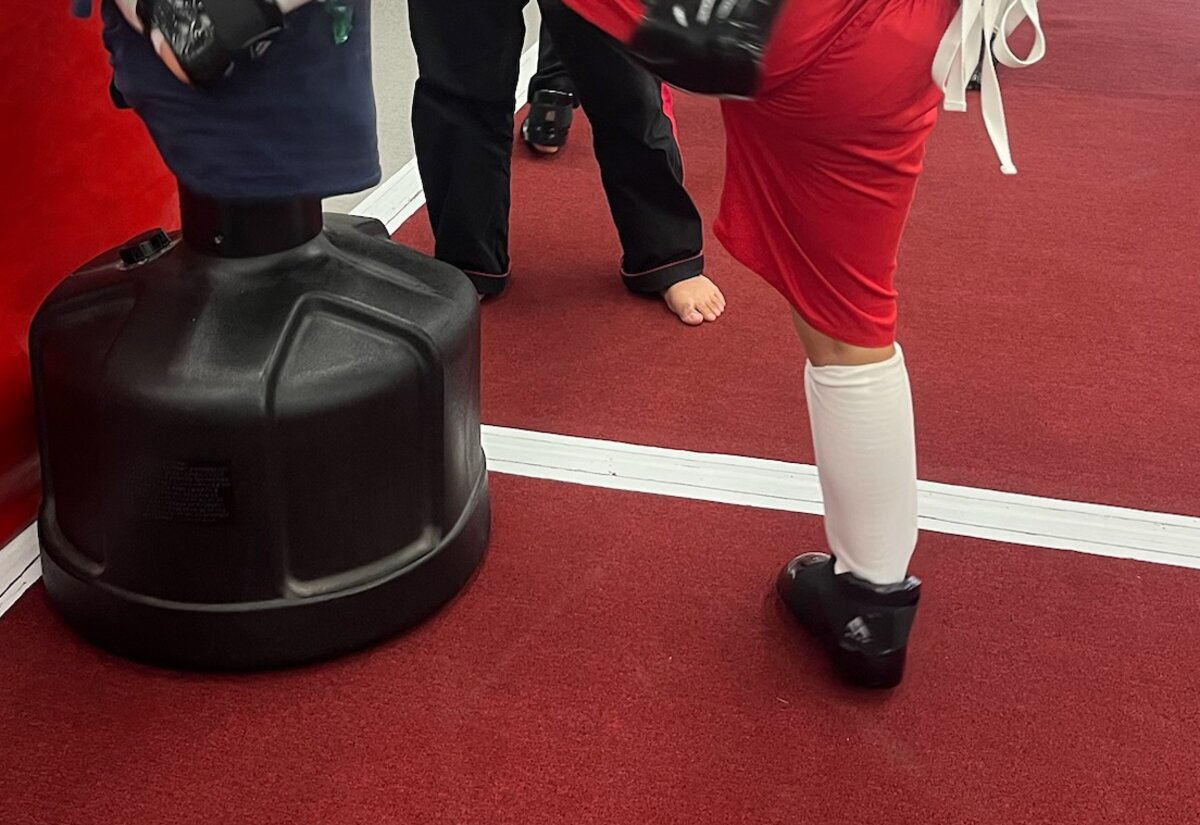
Tae Kwon Do classes use a small set of Korean words: commands such as charyeot for attention and junbi for ready, the numbers one to ten, titles for the instructors, and names for the uniform, the belt, the kicks and the forms. Children learn them by hearing them in class, and this glossary gives each word in plain English with a guide to saying it, so you can follow along and practice at home.
Chung TKD in New Hyde Park teaches Tae Kwon Do to children ages 2 to 13, in three programs by age: Pee-Wee, Children and Youth. Grandmaster Howard Chung, 9th Dan, has taught Tae Kwon Do since 1970 and opened the school in 1984. This glossary is by Master Chris J. Chung, 5th-degree black belt.
What do the Korean commands in class mean?
The commands tell a class when to stand at attention, bow, get ready, start, stop and rest, and they are the words a child hears most.
- Charyeot, pronounced cha-ryuht, means attention. It is also written charyot or charyo.
- Gyeongnye, pronounced kyung-nyeh, means bow. It is also written kyung ye.
- Junbi, pronounced joon-bee, means ready.
- Sijak, pronounced shee-jahk, means begin.
- Geuman, pronounced kuh-mahn, means stop.
- Baro, pronounced bah-roh, means return to the ready position.
- Swieo, pronounced shwee-uh, means relax, or at ease.
- Gyesok, pronounced kyeh-sohk, means continue.
- Dwirodora, pronounced dwee-roh-doh-rah, means turn around.
- Haesan, pronounced heh-sahn, means class dismissed.
These spellings follow the Korean terms tables in Wikipedia's Taekwondo entry.
What is a kihap?
A kihap, pronounced kee-hahp and also written gihap, is the short, loud shout a student gives with a kick or a punch. Ki means energy and hap means to join, as Wikipedia's Kiai entry explains, and karate has the same shout under its Japanese name, kiai.
How do you count to ten in Korean for Tae Kwon Do?
Tae Kwon Do classes count with the native Korean numbers, from hana for one up to yeol for ten, often while the class repeats a kick or a punch.
- Hana, pronounced hah-nah, means one.
- Dul, pronounced dool, means two.
- Set, pronounced set, means three.
- Net, pronounced net, means four.
- Daseot, pronounced dah-suht, means five.
- Yeoseot, pronounced yuh-suht, means six.
- Ilgop, pronounced eel-gohp, means seven.
- Yeodeol, pronounced yuh-duhl, means eight.
- Ahop, pronounced ah-hohp, means nine.
- Yeol, pronounced yuhl, means ten.
If you look up Korean numbers and find il, i and sam, those are a second set, borrowed from Chinese and used for dates, money and phone numbers, as Wikipedia's Korean numerals entry explains. Classes count with hana, dul, set.
What do you call the instructors, and what do the ranks mean?
Titles for teachers end in nim, a Korean word of respect that works much like Mr. or Ms. in English, as Wikipedia's Korean honorifics entry explains.
- Sabeomnim, pronounced sah-bum-nim, means master instructor. It is also written sabumnim.
- Gwanjangnim, pronounced gwahn-jahng-nim, means the head of the school.
- Seonbae, pronounced suhn-beh, means a senior student.
- Geup, pronounced gup, is a color belt rank. It is also written kup.
- Dan, pronounced dahn, is a black belt rank, also called a degree.
Color belt ranks count down toward black belt, so each new color belt has a lower geup number, and black belt degrees count up, Wikipedia's Taekwondo entry notes. Grandmaster Howard Chung is a 9th Dan, a ninth-degree black belt. Master Chris J. Chung is a 5th-degree black belt. Ask your child's instructor which title to use in class. Our guide to the belt colors in order has the full list of belts.
What are the words for the uniform, the belt and the training hall?
The uniform is the dobok, the belt is the tti and the training hall is the dojang.
- Dobok, pronounced doh-bohk, is the uniform. Do means way and bok means clothing, as Wikipedia's Dobok entry explains.
- Tti, pronounced dee, is the belt. It is also written ti.
- Dojang, pronounced doh-jahng, is the training hall where classes meet.
- Simsa, pronounced sim-sah, is a belt test.
At Chung TKD, a child below brown belt tests for the next belt when the instructors judge them ready. Grandmaster Chung runs the test, and the instructors demonstrate.
What are the Korean names for kicks, punches and blocks?
Most technique names join a direction to the move, so ap chagi is a front kick, because ap means front and chagi means kick.
- Chagi, pronounced chah-gee, means kick.
- Ap chagi, pronounced ahp chah-gee, is a front kick.
- Yeop chagi, pronounced yuhp chah-gee, is a side kick.
- Dollyeo chagi, pronounced dohl-yuh chah-gee, is a roundhouse kick, also called a turning kick.
- Dwi chagi, pronounced dwee chah-gee, is a back kick.
- Jireugi, pronounced jee-ruh-gee, is a punch.
- Makgi, pronounced mahk-gee, is a block. It is also written makki.
- Seogi, pronounced suh-gee, is a stance. Junbi seogi is the ready stance.
- Gyeokpa, pronounced gyuhk-pah, is board breaking.
- Hosinsul, pronounced hoh-sheen-sool, is self-defense.
- Matseogi, pronounced maht-suh-gee, is sparring in ITF schools. Gyeorugi, pronounced gyuh-roo-gee, is the word in World Taekwondo schools.
Self-defense is part of class at Chung TKD. Our guide to why Tae Kwon Do students break boards explains what gyeokpa teaches.
What are forms, and why are they called hyung?
A form is a set pattern of moves a student learns for a belt, and Korean has three common words for it: hyung, tul and poomsae.
- Hyung, pronounced hyuhng, is the older word, used in traditional Tae Kwon Do.
- Tul, pronounced tool, is the word in ITF schools.
- Poomsae, pronounced poom-seh, is the word in World Taekwondo schools.
Wikipedia's Hyeong entry gives all three. At Chung TKD, color belts learn the ITF forms, called hyung, and black belts learn the forms Kwang-Gae and Koryo. The first of the 24 ITF forms is Chon-Ji, which means heaven and earth, as Wikipedia's Teul entry lists.
Why is the same word spelled different ways?
Korean has its own alphabet, Hangul, and more than one way to write it in English letters, so one word can be spelled several ways. The two main systems are South Korea's official one and the older McCune-Reischauer system, as Wikipedia's Romanization of Korean entry explains. Charyeot, charyot and charyo are the same command. Styles differ too, so an ITF school may use a different word from a World Taekwondo school for the same thing, as with tul and poomsae. Go by how your child's instructor says each word.
How can your child practice the words at home?
Use the words in short games a few at a time, and let your child be the expert.
- Count jumping jacks, stairs or toys from hana to yeol.
- Call out charyeot, junbi and sijak, and let your child show what each one means.
- Ask your child to teach you one new word after each class.
- Bow to each other with gyeongnye before and after you practice together.
Our guide to practicing Tae Kwon Do at home has more ideas.
Trying Tae Kwon Do at Chung TKD
Every new family starts with two free trial classes, and a parent or guardian stays for them. Children wear something comfortable, sweats or shorts, and the uniform comes when a family signs up. Our guide to what to expect at a first class walks through a first visit.
Questions parents ask
What does Tae Kwon Do mean?
The name, also written taekwondo, means the way of the foot and the hand. Tae means to strike with the foot, kwon to strike with the hand, and do the way.
How do you say attention and bow in Tae Kwon Do?
Attention is charyeot, pronounced cha-ryuht, and bow is gyeongnye, pronounced kyung-nyeh. They are also written charyot and kyung ye.
How do you count to ten in Korean for Tae Kwon Do?
One to ten is hana, dul, set, net, daseot, yeoseot, ilgop, yeodeol, ahop and yeol. These are the native Korean numbers, the ones used for counting.
What do you call a Tae Kwon Do instructor?
Many schools say sabeomnim, pronounced sah-bum-nim, which means master instructor. The nim at the end is a word of respect.
Does my child need to know the Korean words before a first class?
No. Children learn the words by hearing them in class, so no one needs to know them before a first class.