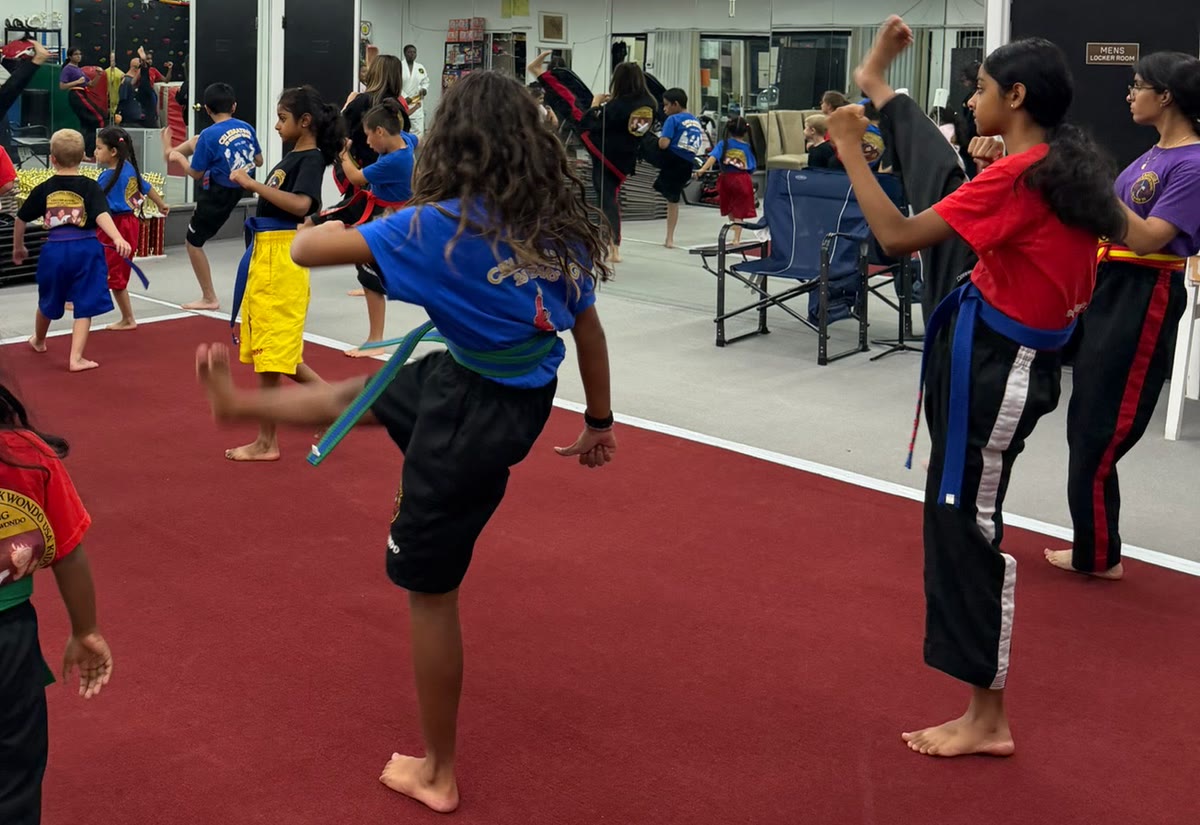
To do an axe kick, raise the kicking leg high, straight or nearly straight, stop it at the top, then pull it straight down so the heel comes down on the target, like an axe. The leg can rise straight up the middle, or on an outside or an inside arc, the way a crescent kick starts. A child should learn it in class, under an instructor, before practicing it at home.
Chung TKD in New Hyde Park teaches Tae Kwon Do, a Korean martial art also written taekwondo, to children ages 2 to 13, in three programs by age: Pee-Wee, Children and Youth. Grandmaster Howard Chung, 9th Dan, has taught Tae Kwon Do since 1970 and opened the school in 1984. This guide is by Master Chris J. Chung, 5th-degree black belt.
What is an axe kick?
A kick that comes down from above, with a straight leg and the heel dropping onto the target like the blade of an axe, as Wikipedia's Kick entry describes it. The same entry says it is also called a hammer kick. It begins with the foot rising as in a crescent kick, then the rising arc stops and the foot comes down onto the target from above. It is one of the five basic kicks in our guide to the basic Tae Kwon Do kicks.
What is an axe kick called in Korean?
Naeryeo chagi. Wikipedia's list of taekwondo techniques spells it naeryeo chagi, and the Fight Encyclopedia also gives it as naeryo chagi and translates it as downward kick. Chagi means kick, so the name says what the kick does.
How do you do an axe kick, step by step?
Here are the five steps for an axe kick with the back leg.
- Stand in a fighting stance, with the kicking leg in back and both hands up.
- Raise the back leg up in front of the body, straight or nearly straight, with the toes pointing up.
- Stop the leg at the top of the rise, instead of letting it swing through.
- Pull the leg straight down through the target, so the heel leads.
- Set the foot down under control, toes first, back in the fighting stance.
Our guide to Tae Kwon Do stances shows the fighting stance the kick starts from.
What are the three ways the leg can rise?
Straight up the middle, or on an outside or an inside arc. Wikipedia's list of taekwondo techniques says the leg usually rises from the outside of the body, like an outside crescent kick, and that the rise can also come from the inside, or straight up and down. Whichever way it rises, the leg stops at the top and comes straight down, heel first.
- Straight up. The leg rises up the middle of the body, then comes straight back down.
- Outside arc. The leg rises across the front of the body and sweeps out, as an outside crescent kick starts, then stops and comes down.
- Inside arc. The leg rises out to the side and sweeps in, as an inside crescent kick starts, then stops and comes down.
Ask your child's instructor which way to practice.
How is an axe kick different from a crescent kick?
By what happens at the top. A crescent kick keeps sweeping across, so the edge of the foot hits the target from the side. An axe kick stops the arc at the top and comes straight down, so the heel hits from above. Our guide to how to do a crescent kick breaks the inside and outside crescent kicks into four steps each.
How is an axe kick different from a front kick or a roundhouse kick?
By the way the leg travels. A front kick and a roundhouse kick both lift the knee first, then snap the leg out, straight ahead in a front kick and in from the side in a roundhouse kick. An axe kick keeps the leg straight or nearly straight on the way up and brings the heel down from above. Our guide to how to do a roundhouse kick breaks that kick into five steps.
What should I look for when my child does an axe kick?
Watch five things, from the start of the kick to the finish.
- The rise. The leg comes up in front of the body, straight or nearly straight, with the toes pointing up.
- The stop. The leg stops at the top instead of swinging on through or across.
- The drop. The leg comes straight down, heel first, pulled down rather than falling.
- The standing leg. The child stays balanced on the standing foot, with the upper body upright and the hands up.
- The finish. The foot lands under control, back in a fighting stance, instead of slapping the floor.
Praise a clean stop and a controlled drop, not how high the leg went. If something looks off, ask an instructor after class rather than correcting it at home.
What are the common mistakes in an axe kick?
Each one undoes one of the five things on the watch list above.
- Pointing the toes on the way up, so the toes lead instead of the heel.
- Letting the leg keep swinging across at the top, instead of stopping and coming straight down.
- Letting the leg just fall, instead of pulling it down heel first.
- Dropping the hands or losing balance on the standing foot.
- Slamming the foot into the floor at the end, instead of setting it down in the stance.
How can my child practice an axe kick safely at home?
By learning it in class first, then kicking in the air, in a clear space, on a soft surface. Go through this checklist with your child before practice.
- Your child has learned the axe kick in class, from an instructor.
- There is clear space in front and all around, since the leg rises high and comes down in front of the body.
- The floor is soft, such as a carpet or a mat, and your child is barefoot rather than in socks.
- Kicks go in the air, never at a person or anything hard, not even for pretend.
- Kicks start low and slow, and height comes when an instructor says so.
- The jumping and spinning axe kicks wait until an instructor has taught them in class and says your child is ready to practice them at home.
Our guide to practicing Tae Kwon Do at home covers what else to practice between classes, and our guide to how to do a tornado kick explains another spinning kick that waits for class.
How does my child learn the axe kick?
In class, under an instructor. At Chung TKD, the school's instructors teach the classes, and classes also cover the ITF forms, called hyung, and self-defense. Ask an instructor after class which kicks your child is working on.
Where is Chung TKD?
Chung TKD is at 1527 Jericho Turnpike, New Hyde Park, NY 11040.
How do we get started?
Start with the two free trial classes. A parent or guardian stays for both, and kids wear something comfortable, sweats or shorts. Book a free class online.
Questions parents ask
What part of the foot hits in an axe kick?
The heel. The leg comes straight down from above, so the heel hits first, with the toes pointing up.
Does the leg bend in an axe kick?
Not much. The steps here keep it straight or nearly straight, and some versions bend the knee a little, so ask your child's instructor which way to practice it.
What does naeryeo chagi mean?
Downward kick. Naeryeo chagi, also written naeryo chagi, is a Korean name for the axe kick, and chagi means kick.
Can my child practice axe kicks at home?
Yes, once an instructor has shown them the kick in class. Kick in the air, in a clear space, on a soft surface, barefoot, and never at a person.
Is an axe kick the same as a crescent kick?
No. Both can start with the same rising arc, but a crescent kick sweeps across and hits with the edge of the foot, while an axe kick stops at the top and comes straight down with the heel.