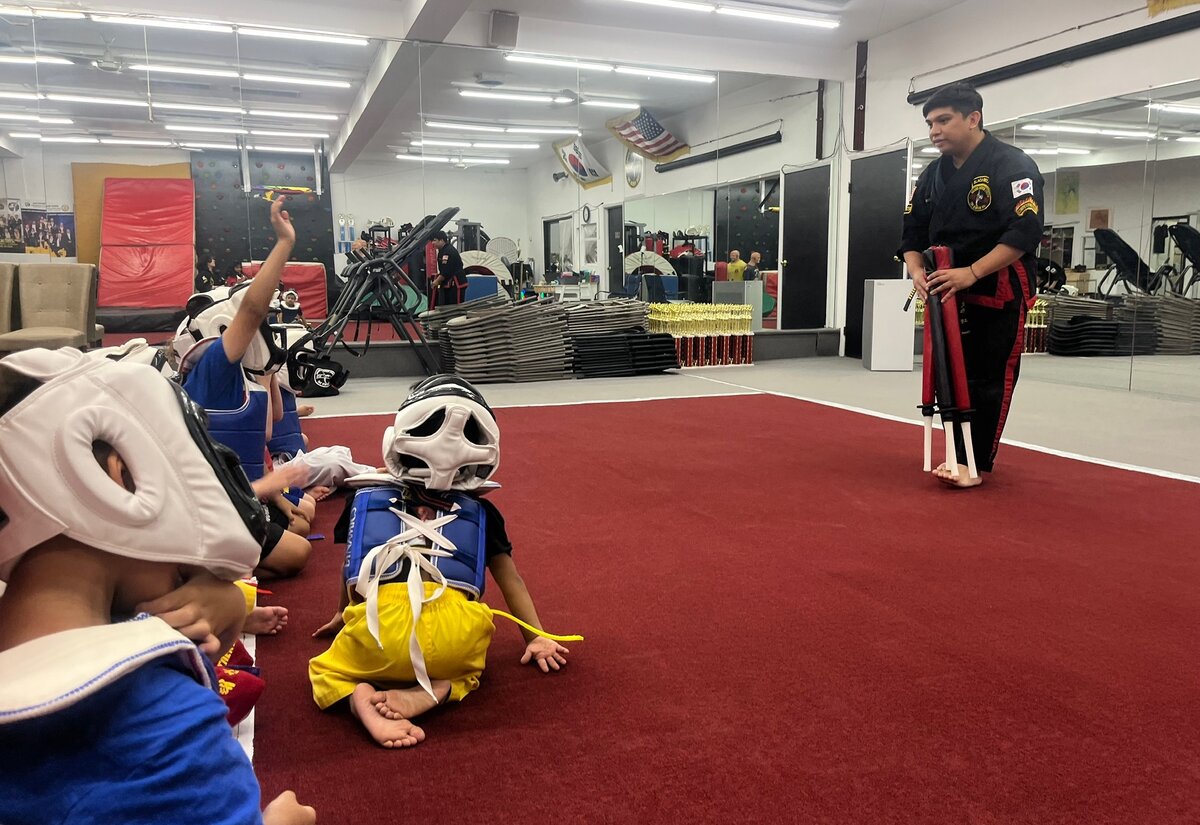
A dojang is the training hall where Tae Kwon Do is taught and practiced. The word is Korean and means place of the Way, and it is written with the same two characters as the Japanese word dojo. Students of Tae Kwon Do and other Korean martial arts train in a dojang, while students of karate and judo train in a dojo.
Chung TKD in New Hyde Park teaches Tae Kwon Do, a Korean martial art also written taekwondo, to children ages 2 to 13, in three programs by age: Pee-Wee, Children and Youth. Grandmaster Howard Chung, 9th Dan, has taught Tae Kwon Do since 1970 and opened the school in 1984. This guide is by Master Chris J. Chung, 5th-degree black belt.
What does the word dojang mean?
A training hall, or word for word, place of the Way. Wikipedia's Taekwondo entry says the school or place where Tae Kwon Do is taught is called a dojang. The word has two parts, do for way and jang for place, as Wiktionary's entry for the word shows. It is pronounced doh-jahng. Our parent's glossary covers the other Korean words a child hears in class, such as dobok for the uniform.
Is a dojang the same as a dojo?
Yes, in meaning. Dojang is the Korean word and dojo is the Japanese one, so a Tae Kwon Do class trains in a dojang and a karate or judo class trains in a dojo. Wikipedia's Dojo entry calls the Korean dojang fairly similar to the Japanese dojo. For how the two arts compare, read Tae Kwon Do vs karate.
What happens in a dojang?
Training in everything Tae Kwon Do covers, from forms and sparring to belt tests. Wikipedia's Taekwondo entry lists forms, sparring, breaking, self-defense, etiquette and respect, and tests to move up to the next rank. Students train in a uniform called a dobok, with a belt tied around the waist. At Chung TKD, the school's instructors teach the classes, and classes cover the ITF forms, called hyung, and self-defense. Grandmaster Chung runs every belt test, and families have a seat and watch.
What are the customs in a dojang?
Respect for the room and the people in it, shown in a few simple habits. Each dojang sets its own customs, and these four are common.
- Shoes come off. Students train barefoot, and Wikipedia's Dojo entry notes that shoes are not worn in a dojo, to keep the hall clean.
- Students bow. A bow, gyeongnye in Korean, shows respect to the instructor and to a partner before and after they practice together.
- Students follow the instructor's commands. The commands tell the class when to stand at attention, bow, start and stop.
- Everyone takes care of the room. Wikipedia's Dojo entry says a dojo is well cared for by the people who train in it.
A new student learns the customs in class, by following the instructor and the students around them.
Can parents watch in the dojang?
Yes. Parents can watch their child's class at Chung TKD, and a parent or guardian stays at the school for the two free trial classes. Families also have a seat and watch every belt test, and they watch the school's in-house tournaments, held twice a year, with forms, sparring and breaking. Our articles on whether parents can watch a class and kids' Tae Kwon Do tournaments say more.
How should I watch from the side of the mat?
Quietly, with your attention on your child. Cheer the effort, leave the teaching to the instructors and save any corrections for later. If your child is nervous, sit where they can see you. After class, ask an instructor what your child can work on, and our guide to practicing Tae Kwon Do at home has ideas for between classes.
What should I ask when I visit a dojang?
Here are six questions to ask on a visit, with Chung TKD's answers.
- Who teaches the classes? The school's instructors teach the classes, and Grandmaster Chung runs every belt test.
- How are classes grouped? By age. Pee-Wee is for the youngest, with Mommy & Me at ages 2 to 3 and an independent class from 3½. Children is for ages 4 to 6 and Youth for ages 7 to 13, and both are also split by belt.
- Can I watch? Yes. Parents can watch class, and a parent or guardian stays for the two free trial classes.
- What will my child learn? Tae Kwon Do, with the ITF forms, called hyung, and self-defense as part of class.
- How does belt testing work? Below brown belt, a child tests when the instructors say they are ready. From brown belt on, tests are on set dates.
- How do we try it? With two free trial classes. Kids wear something comfortable, sweats or shorts, and the uniform comes if they sign up.
Ask the same questions at any school you visit. Our guide to choosing a martial arts school covers more.
Where is the Chung TKD dojang?
Chung TKD is at 1527 Jericho Turnpike, New Hyde Park, NY 11040.
How do we get started?
Start with the two free trial classes. A parent or guardian stays for both, and kids wear something comfortable, sweats or shorts. Our guide to a first Tae Kwon Do class walks through the visit. Book a free class online.
What is a dojang?
The training hall where Tae Kwon Do is taught and practiced. The word is Korean and means place of the Way.
Is a dojang the same as a dojo?
Yes, in meaning. Dojang is the Korean word, used in Tae Kwon Do, and dojo is the Japanese word, used in karate and judo.
How do you pronounce dojang?
Doh-jahng.
Do students wear shoes in a dojang?
Not on the training floor. Students train barefoot, as they do in a Japanese dojo.
Can parents watch class at Chung TKD?
Yes. Parents can watch, and a parent or guardian stays for the two free trial classes.
How do we start at Chung TKD?
With two free trial classes. A parent or guardian stays for both.