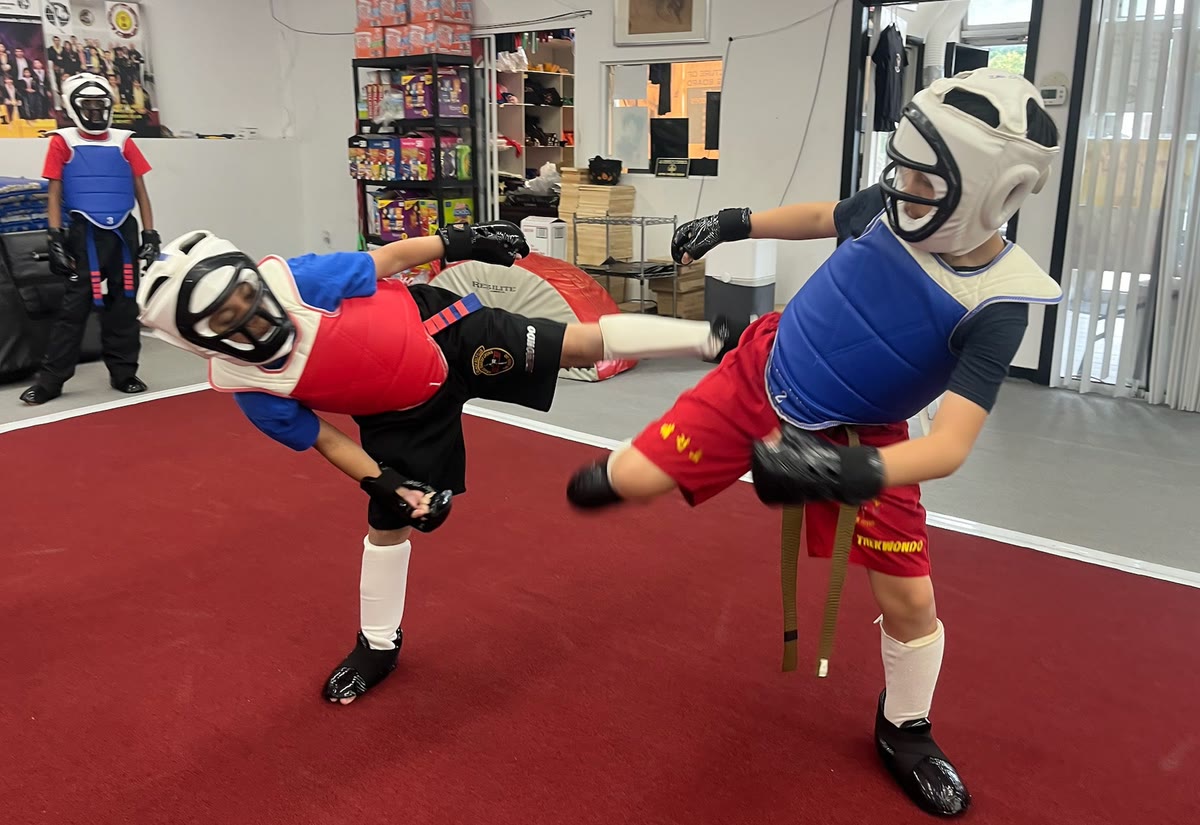
Tae Kwon Do sparring is partner practice in which two students use the kicks, punches and blocks they have learned against each other, with control and in protective gear, while an instructor watches. Children usually build up to it in steps, from set partner drills to light free sparring, and each school decides when a child starts, often by belt rank rather than age.
Chung TKD in New Hyde Park teaches Tae Kwon Do to children ages 2 to 13, in three programs by age: Pee-Wee, Children and Youth. Grandmaster Howard Chung, 9th Dan, has taught Tae Kwon Do since 1970 and opened the school in 1984. Sparring is one of the events at the school's in-house tournaments, held twice a year. This guide is by Master Chris J. Chung, 5th-degree black belt.
What is sparring in Tae Kwon Do?
Sparring is where students use their techniques against a partner who moves and answers back, instead of against the air or a target. World Taekwondo calls it gyeorugi and ITF schools call it matseogi, as Wikipedia's Taekwondo entry notes. In a kids class, sparring is about control, timing and staying calm, and the instructor sets how much contact is allowed.
What kinds of sparring do kids do?
Children meet several kinds of sparring as they move up the belts.
- Step sparring. Partners agree on the attacks and the blocks in advance and practice them as a set, so a child learns distance and timing without surprises. Wikipedia lists three-, two- and one-step sparring among these drills.
- Free sparring. There are no set moves. Both partners attack and defend as they choose, with the contact the instructor allows.
- Point sparring. A referee stops the match each time a point is scored and then restarts it, and contact is light.
- Olympic-style sparring. World Taekwondo sparring is full contact and keeps going when a point is scored, and major tournaments score it electronically.
What protective gear do kids wear for sparring?
The gear depends on the style and the school. ITF Tae Kwon Do usually pads only the hands and feet, and a head guard is optional. World Taekwondo, the Olympic style, always uses a padded helmet and a chest protector called a hogu, plus protectors for the feet, shins, groin, hands and forearms, as Wikipedia's Taekwondo entry describes. Its competition list adds a mouthpiece.
A full World Taekwondo set includes:
- A head guard.
- A chest protector, or hogu.
- Hand and foot pads.
- Shin and forearm guards.
- A mouthguard.
- A groin cup.
Buy by fit, not by age, since two children the same age can need different sizes. Before you buy anything, ask the school which pieces your child needs, because many schools and tournaments set a type or a color. Ask at your trial class which gear Chung TKD uses.
How are kids matched for sparring?
Kids spar partners of a similar size, age and rank, so neither child has a big advantage. In class, the instructor pairs the children. At tournaments, children spar in divisions by age and belt rank, and many tournaments add weight. At the top level, competitors are matched within gender and weight division, Wikipedia's Taekwondo entry notes. At Chung TKD's in-house tournaments, the divisions are kept small. Our guide to the belt colors in order shows how rank is counted.
When do kids usually start sparring?
There is no single age. Children usually learn the pieces first: kicks and punches on pads and targets, then step sparring with a partner, then light free sparring in gear. Many schools add free sparring once a child has the basic kicks and blocks and can follow the instructor's commands, so the start is often tied to belt rank rather than to a birthday. Ask at your trial class when sparring starts in your child's classes at Chung TKD. Our guide to moving up the Tae Kwon Do belts explains how a child moves through the ranks.
How does scoring work in sparring?
In a tournament match, the referee and judges give points for controlled kicks and punches that land on the allowed targets. Under World Taekwondo rules, a punch to the chest protector earns 1 point, a kick to it earns 2, a kick to the head earns 3, and turning kicks earn more. Punches to the head are not allowed, as Wikipedia's Taekwondo entry describes. ITF rules score punches to the body and the head, and give more points for jumping kicks. Each tournament sets its own rules for children, including whether kicks to the head are allowed, so read them before your child spars.
Is sparring safe for kids?
Sparring has some risk of bumps and bruises, as any contact sport does. Look for these in any class where children spar:
- An instructor who watches every pair and stops a match for anything unsafe.
- Partners matched by size, age and rank.
- Gear that fits and stays in place.
- Contact kept light, and set by the instructor for each level.
- A bow to the partner before and after, so both children treat it as practice, not a fight.
How can parents help a nervous child?
Talk about sparring as practice with a partner, not a fight, and let your child watch students spar before they try it. Our guide on whether parents can watch a class covers watching from the side of the mat. Practicing the guard position and basic kicks at home builds confidence, and our guide to practicing Tae Kwon Do at home has ideas. After a class, ask what your child's favorite part was, the question our guide to a first Tae Kwon Do class suggests.
What should you ask about sparring at a trial class?
Bring these questions to your child's trial class, or ask the instructor after it.
- When does sparring start in my child's classes, and at which belt?
- Does my child spar in every class, or only in some?
- Which gear does my child need, and does the school set a type or a color?
- How are partners paired: by size, by age or by rank?
- How much contact is allowed at my child's level, and are kicks to the head allowed?
- Who watches each pair while they spar?
- Can my child choose whether to spar at the in-house tournaments?
- Can I watch a class where students spar?
Where does sparring fit at Chung TKD?
Sparring is one of three events at Chung TKD's in-house tournaments, with forms and breaking. The tournaments are held twice a year, the divisions are kept small, and families watch. The Competition Team trains invited students to compete in tournament divisions, and the classes page describes it and the school's other programs. For sparring in regular classes, ask at your trial class.
Trying Tae Kwon Do at Chung TKD
Every new family starts with two free trial classes, and a parent or guardian stays for them. Children wear something comfortable, sweats or shorts, and the uniform comes when a family signs up.
Questions parents ask
Is sparring the same as fighting?
No. Sparring is practice with rules, protective gear and a partner of a similar size and rank, and the instructor stops it for anything unsafe. The aim is to use techniques with control, not to hurt anyone.
What is step sparring?
Step sparring is a partner drill where both children agree on the attacks and the blocks in advance, usually in three-, two- or one-step sets. It teaches timing and distance before free sparring.
What does gyeorugi mean?
Gyeorugi is the Korean word World Taekwondo uses for sparring. ITF schools call sparring matseogi.
Do kids need a full set of sparring gear?
It depends on the school and the style. ITF Tae Kwon Do usually pads only the hands and feet, while World Taekwondo adds a helmet, a chest protector and more. Ask at your trial class which gear your child needs before you buy.
Is there sparring at Chung TKD's tournaments?
Yes. Sparring is one of the events at Chung TKD's in-house tournaments, with forms and breaking, and families watch.