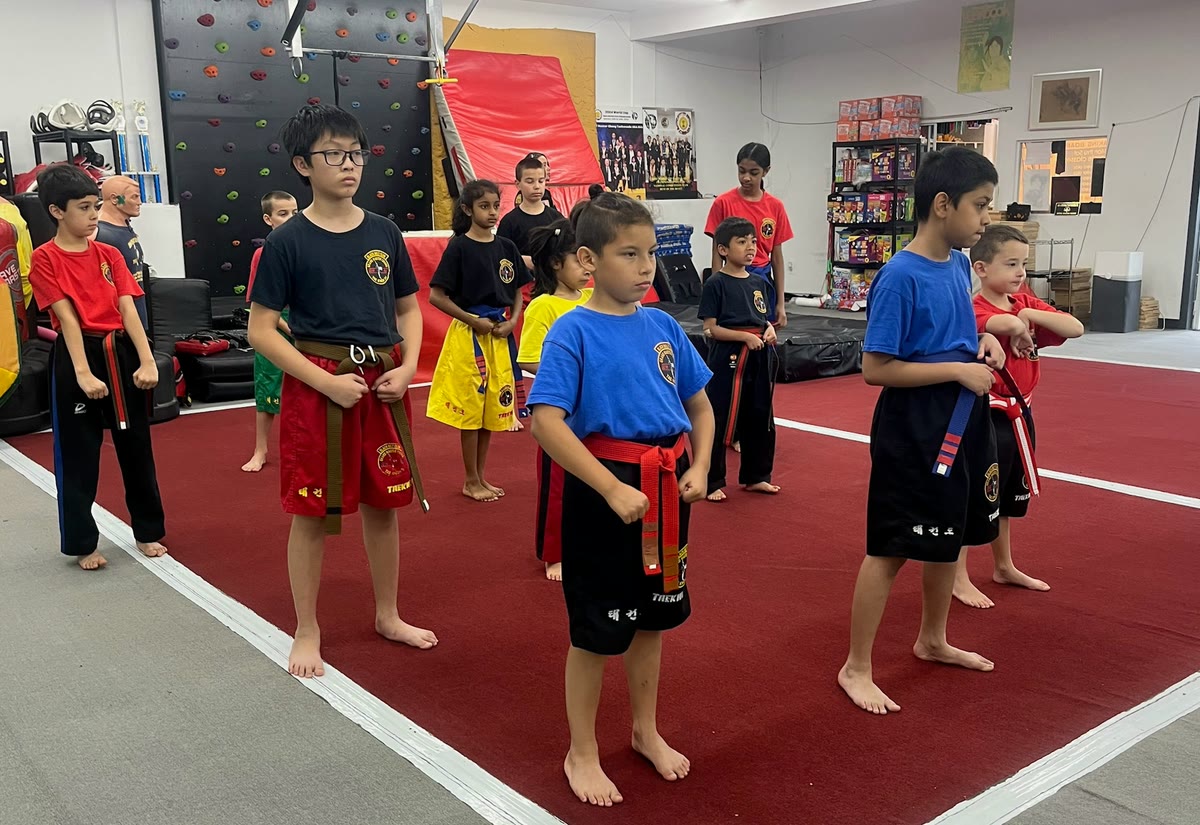
There is no single karate belt order. A common one runs white, yellow, orange, green, blue, brown and black, from lighter colors to darker ones, but each style, and often each school, sets its own colors and order. Tae Kwon Do belts work the same way, so a belt color tells you a child's rank only inside their own school.
Chung TKD in New Hyde Park teaches Tae Kwon Do, a Korean martial art, to children ages 2 to 13. It does not teach karate. Grandmaster Howard Chung, 9th Dan, has taught Tae Kwon Do since 1970 and opened the school in 1984. For the school's own belts, read the Tae Kwon Do belt order at Chung TKD. This guide is by Master Chris J. Chung, 5th-degree black belt.
What is the most common karate belt order?
Here is a common order, from the first belt to black belt, as Wikipedia's entry on kyu ranks gives it:
- White
- Yellow
- Orange
- Green
- Blue
- Brown
- Black
White is often the first belt and brown the last color before black, and the colors usually get darker as a student moves up. Some schools add more colors, such as purple, and some mark a step inside one color with a stripe, as the two styles below show.
Why is there no single karate belt order?
Because karate started with only a few belt colors, and schools added their own over time. At first, karate had only three belt colors, white, brown and black, as Wikipedia's entry on Shotokan explains, and most Shotokan schools have since added others. The ranks came from judo. Gichin Funakoshi, the founder of Shotokan karate, adopted the kyu and dan ranks of Jigoro Kano, the founder of judo, as Wikipedia's entry on karate explains. Each school or organization picks its colors on its own, so the same color can mean a different rank from one school to the next.
What do kyu and dan mean in karate?
A kyu is a color belt rank, and a dan is a black belt degree. Kyu ranks count down, so a beginner starts at a high number, such as 10th kyu, and 1st kyu is the last rank before black belt. Dan ranks count up, starting at the first black belt, which karate calls shodan. To earn each rank, a student shows the kata for that rank, the set patterns of moves, as Wikipedia's entry on karate describes.
How does the belt order change from one karate style to another?
Two well-known styles show how far apart the orders can be.
- Shotokan. In the first Shotokan ranks, as Wikipedia's entry on Shotokan gives them, students wore a white belt from 8th to 4th kyu, a brown belt from 3rd to 1st kyu and a black belt from first dan. Most Shotokan schools now add colors between white and brown, such as purple.
- Kyokushin. In the order Kyokushin's headquarters used under Mas Oyama, as the Kyokushin grading page at MasutatsuOyama.com lists it, students go from white to orange, blue, yellow, green and brown, then black. White means a student is not yet graded. Each color from orange to brown holds two kyu ranks, and the second adds a black stripe. Blue comes before yellow, the reverse of the common order, and some Kyokushin groups use a different order again.
How do Tae Kwon Do belts compare with karate belts?
The two systems are built the same way, from color belts to black belt, and differ in their names and their colors.
- Color belt ranks. Karate calls them kyu, and Tae Kwon Do calls them gup, also written geup. In both, the numbers usually count down toward black belt, as Wikipedia's entry on Tae Kwon Do explains.
- Black belt degrees. Both arts call them dan, and in both the degrees count up.
- Colors. Both arts use colored belts on the way to black belt, and in both the colors and their order change from style to style and school to school.
- Stripes. In both arts, some schools add a stripe to a belt to mark a step before the next color.
- Forms. Karate calls its set patterns of moves kata. Tae Kwon Do has forms too, called hyung at Chung TKD, and in both a student learns new ones on the way to black belt.
- Tests. In both arts, a student passes a test to move up a rank.
So a belt color alone does not tell you how two children at different schools compare, even in the same art. For how the two arts differ beyond belts, read Tae Kwon Do vs karate.
What should I ask a school about its belts?
Ask these six questions at any karate or Tae Kwon Do school before your child starts. The answers tell you more than the colors do.
- What is your belt order, from the first belt to black belt?
- What does my child need to learn for each new belt?
- Do you give stripes between belts, and what earns one?
- Who decides when my child is ready to test, and are tests on set dates?
- Who runs the belt tests, and can families watch?
- What comes after black belt?
How do belts work at Chung TKD?
Here is how Chung TKD answers those six questions.
- Belt order. The Tae Kwon Do belt order at Chung TKD lists every belt in order, with the form for each one.
- What to learn. Color belts learn the ITF forms, called hyung, and each belt test asks a little more than the one before.
- Stripes. A child earns a stripe for a class they attended where their curriculum was reviewed. Our guide to how stripes work in Tae Kwon Do explains more.
- Testing. Below brown belt, a child tests when their instructors judge them ready. From brown belt on, tests are on set dates. Read how belt testing works in Tae Kwon Do for the details.
- Who runs the tests. Grandmaster Chung runs every belt test, and the school's instructors demonstrate. Families have a seat and watch. Black belt tests are big events, and the school's past black belts come back for them.
- After black belt. Black belts learn the forms Kwang-Gae and Koryo.
To tie a belt at home, read how to tie a karate belt or Tae Kwon Do belt. For the road to black belt, read how long it takes to earn a black belt in Tae Kwon Do.
Which class is my child in at Chung TKD?
Chung TKD has three programs by age. Pee-Wee is for ages 2 to 3, Children is for ages 4 to 6 and Youth is for ages 7 to 13. Searching for karate for your child? Read kids karate classes and Tae Kwon Do.
Can my child try a class at Chung TKD first?
Yes. New families at Chung TKD start with two free trial classes, and a parent or guardian stays for both. Kids wear something comfortable, sweats or shorts.
Where is Chung TKD?
Chung TKD is at 1527 Jericho Turnpike, New Hyde Park, NY 11040.
How do we get started?
Start with the two free trial classes in your child's program. Book a free class online.
Questions parents ask
What is the karate belt order?
There is no single order. A common one runs white, yellow, orange, green, blue, brown and black, and each style and school can add colors or change the order.
How many belts are there in karate?
It depends on the style and the school. Kyokushin, for example, has ten color belt ranks, called kyu, below black belt, and black belt has its own degrees, called dan.
What is the highest belt in karate?
Black belt. It has its own degrees, called dan, and some karate groups give red belts for high dan grades.
Are karate and Tae Kwon Do belt colors the same?
Not always. Both arts use colored belts on the way to black belt, but each style and school picks its own colors and order. Ask each school for its full belt order.
Is Chung TKD a karate school?
No. Chung TKD in New Hyde Park teaches Tae Kwon Do, a Korean martial art, to children ages 2 to 13.
Can my child try Tae Kwon Do at Chung TKD before we join?
Yes. New families start with two free trial classes, and a parent or guardian stays for both.