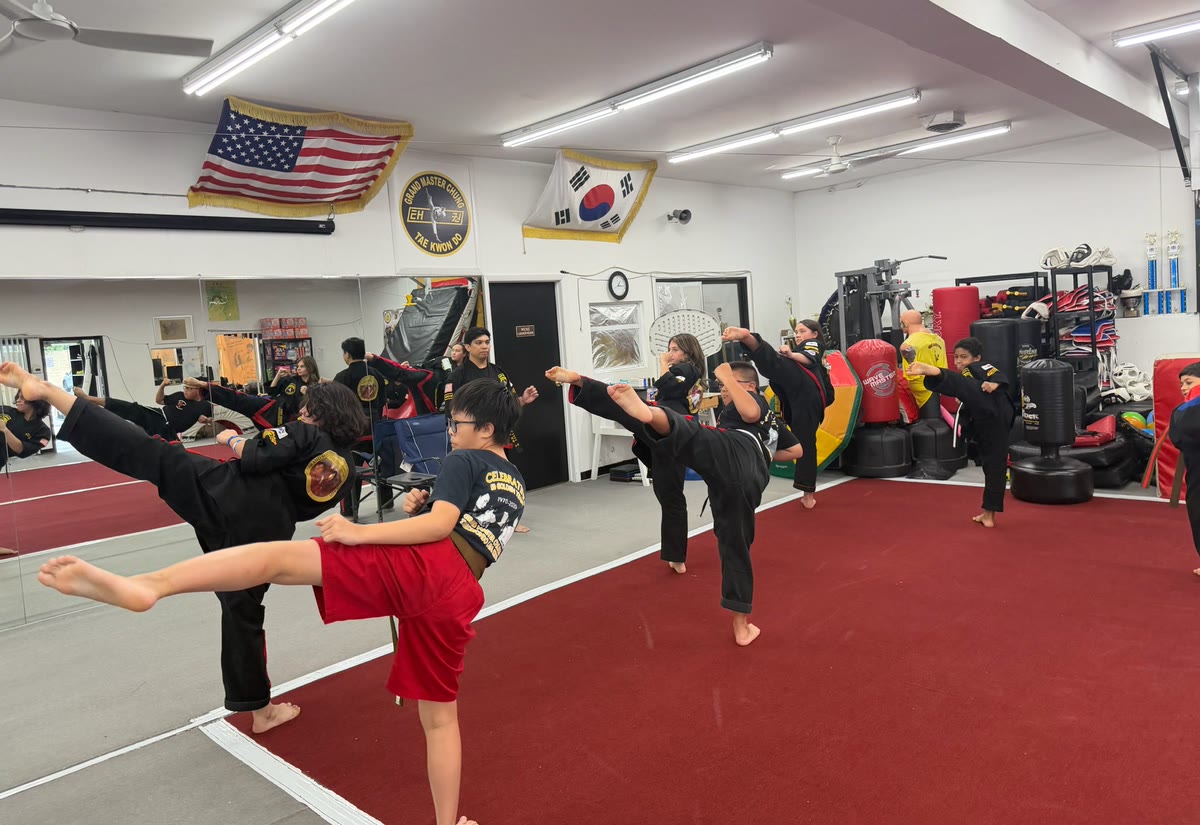
Tae Kwon Do is a Korean martial art known for its kicks. Its name means the way of the foot and the hand, and it is also written taekwondo. Students learn kicks, punches and blocks, set patterns called forms, sparring with a partner, board breaking and self-defense, and they earn a new belt color as they improve.
Chung TKD in New Hyde Park teaches Tae Kwon Do to children ages 2 to 13, in three programs by age: Pee-Wee, Children and Youth. Grandmaster Howard Chung, 9th Dan, has taught Tae Kwon Do since 1970 and opened the school in 1984. This guide is by Master Chris J. Chung, 5th-degree black belt.
What does Tae Kwon Do mean?
The way of the foot and the hand. Wikipedia's Taekwondo entry translates tae as to strike with the foot, kwon as to strike with the hand and do as the art or way. You will see it written taekwondo, tae kwon do or taekwon-do, and all three name the same art. Chung TKD writes it Tae Kwon Do, and TKD is the short form. Our parent's glossary covers the other Korean words a child hears in class.
Where does Tae Kwon Do come from?
Korea. Korean martial artists who had trained in karate and other arts developed Tae Kwon Do in the middle of the twentieth century. The Korean schools that taught it, called kwans, then agreed on one name for their art, taekwondo. South Korea has since named Tae Kwon Do its national martial art.
Who brought Tae Kwon Do to the United States?
Supreme Grand Master Jhoon Rhee is widely known as the father of American Tae Kwon Do, for bringing the Korean martial art to the United States. Wikipedia's Jhoon Rhee entry says he opened his first American school in Washington, D.C. He is also widely known as a teacher of Bruce Lee and Muhammad Ali. Grandmaster Chung trained in the direct lineage of Supreme Grand Master Jhoon Rhee.
What are the styles of Tae Kwon Do?
There are two main styles, ITF and World Taekwondo, and each has its own forms and its own sparring rules. ITF Tae Kwon Do comes from the International Taekwon-Do Federation, founded by Choi Hong-hi, who had argued for the name Tae Kwon Do. World Taekwondo follows the style of the Kukkiwon in Seoul, a style sometimes called sport Tae Kwon Do. In ITF sparring, hand attacks to the head are allowed, and in World Taekwondo sparring, punches to the head are not. Traditional Tae Kwon Do is a name for the arts the original kwans taught, and some ITF students use it for the ITF style. If you are comparing schools, ask which style each one teaches, since the style decides which forms a child learns. Chung TKD teaches the ITF forms, called hyung.
Is Tae Kwon Do an Olympic sport?
Yes. Wikipedia's entry says Tae Kwon Do was first a demonstration event at the Seoul Olympics and became an official medal event at the Sydney Olympics. The Olympic event is sparring, under World Taekwondo's rules. At Chung TKD, sparring is one of the events at the school's in-house tournaments, held twice a year, along with forms and breaking.
What will my child learn in Tae Kwon Do?
There are six parts. Here is each one, with what it looks like at Chung TKD.
- Kicks, punches and blocks. These are the techniques the rest is built from, and Tae Kwon Do is best known for its kicks, including head-height, jumping and spinning kicks.
- Forms. A form is a set pattern of kicks, punches and blocks that a student learns by heart. At Chung TKD, color belts learn the ITF forms, called hyung, and Kwang-Gae and Koryo are the black belt forms.
- Sparring. Two students use what they have learned against each other, with control and in protective gear, while an instructor watches. Our guide to Tae Kwon Do sparring for kids explains how children build up to it.
- Board breaking. A student breaks a board to show a technique works, and Wikipedia's entry says breaking is used for testing, training and demonstrations. Read why Tae Kwon Do students break boards.
- Self-defense. It is part of class at Chung TKD, and its Korean name is hosinsul.
- Respect and character. Wikipedia's entry describes a focus on etiquette, respect, self-confidence and leadership. At Chung TKD, children learn the school's own six values, The Chung TKD Way.
How do belts work in Tae Kwon Do?
A child earns each new belt by performing correctly what that belt asks. At Chung TKD, the belts run from White to Black, and our guide to the belt colors in order lists each one with its form. Between belts, a child earns stripes, and our guide to how stripes work explains them.
Below brown belt, a child tests when the instructors say they are ready. From brown belt on, tests are on set dates. Grandmaster Chung runs every belt test, the instructors demonstrate, and families have a seat and watch. Black belt tests are big events, and the school's past black belts come back for them.
How does Tae Kwon Do compare with other martial arts?
Tae Kwon Do, karate and kung fu teach kicks, punches and forms, while judo and Brazilian jiu-jitsu teach throws, holds and escapes. Tae Kwon Do is Korean and karate is Japanese, and Tae Kwon Do is best known for its kicks. Our side-by-side guides cover Tae Kwon Do vs karate, judo, jiu-jitsu and kung fu, and our guide to which martial art is best for kids helps you weigh them.
What age can my child start Tae Kwon Do?
At Chung TKD, at 2, in the Mommy & Me class. Pee-Wee has Mommy & Me for ages 2 to 3 and an independent class from 3½, Children is for ages 4 to 6 and Youth for ages 7 to 13, and Children and Youth classes are also grouped by belt. The school's instructors teach the classes. A child moves up from Children to Youth by age, or earlier when the staff think they are ready. Our guide to what age kids can start says more.
How do we get started?
Start with the two free trial classes. A parent or guardian stays for both, and kids wear something comfortable, sweats or shorts. The uniform comes if they sign up. Our guide to a first Tae Kwon Do class walks through the visit. Chung TKD is at 1527 Jericho Turnpike, New Hyde Park, NY 11040. Book a free class online.
Questions parents ask
What is Tae Kwon Do?
A Korean martial art known for its kicks. Students learn kicks, punches and blocks, forms, sparring, board breaking and self-defense.
What does Tae Kwon Do mean?
The way of the foot and the hand: tae for the foot, kwon for the hand and do for the way.
Is Tae Kwon Do Korean or Japanese?
Korean. Karate is Japanese, and the two are often compared.
Is Tae Kwon Do an Olympic sport?
Yes. Tae Kwon Do sparring has been an Olympic medal event since the Sydney Olympics.
Which forms does Chung TKD teach?
The ITF forms, called hyung, through the color belts. Kwang-Gae and Koryo are the black belt forms.
How do we start at Chung TKD?
With two free trial classes. A parent or guardian stays for both.