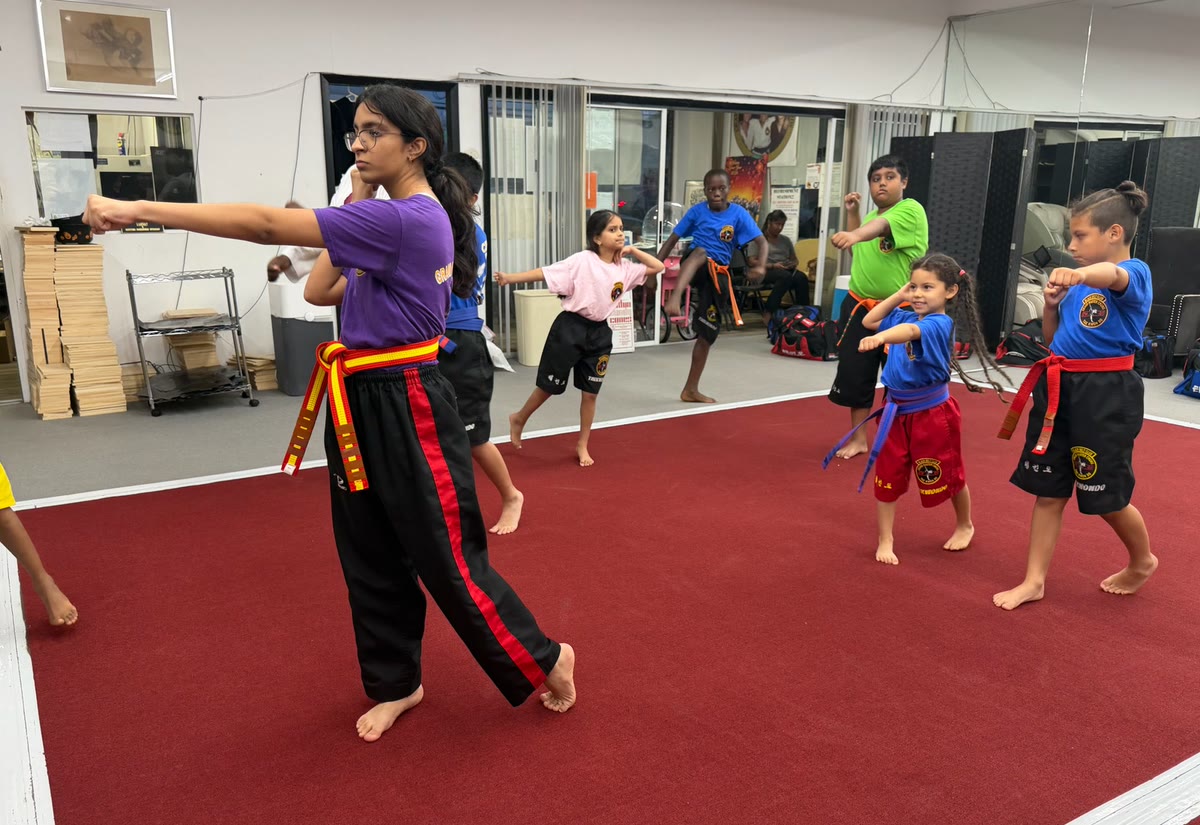
Tae Kwon Do for kids is taught by age, so the right class for your child depends on how old they are and, from age 4, on their belt. At Chung TKD in New Hyde Park, children from 2 to 13 train in three programs: Pee-Wee for 2 and 3, Children for 4 to 6 and Youth for 7 to 13. Every new family starts with two free trial classes, and parents can watch.
Chung TKD teaches Tae Kwon Do, a Korean martial art also written taekwondo, to children ages 2 to 13. Grandmaster Howard Chung, 9th Dan, has taught Tae Kwon Do since 1970 and opened the school in 1984. This page goes age by age, from a 2-year-old's first class to a 13-year-old in Youth, and each age section links to a longer guide or a class page. This guide is by Master Chris J. Chung, 5th-degree black belt.
How does Tae Kwon Do for kids change from 2 to 13?
It changes in three steps, one for each program. Pee-Wee starts at 2, Children starts at 4, and Youth starts at 7, or earlier for a child the staff think is ready.
Inside each program, the classes split again. Pee-Wee has two classes, Mommy & Me for ages 2 to 3 and an independent class from 3½. From 4, Children and Youth classes are grouped by belt as well as by age, so a child trains with classmates who are close to their own age and at their own level.
A child who starts at 2 and a child who starts at 9 do not begin in the same room. Each one begins in the class for their age, and each moves on from there.
Belts matter as much as age once a child is 4. A 9-year-old who started at 2 and a 9-year-old beginner are the same age but may hold different belts, and grouping by belt puts each one in the class that fits.
What does the whole path from 2 to 13 look like?
It runs through six stages, from Mommy & Me at 2 to the Masters Club after black belt. Here they are in order.
- Mommy & Me, ages 2 to 3. The first Pee-Wee class.
- The independent Pee-Wee class, from 3½. The second Pee-Wee class, and the last one before Children.
- Children, ages 4 to 6. Separate classes for White belts, for Gold and Orange belts, for Green, Purple and Blue belts, and for Red and Brown belts.
- Youth, ages 7 to 13, or earlier if the staff think a child is ready and give their permission. Separate classes for White, Gold and Orange belts, for Green, Purple and Blue belts, and for Red and Brown belts.
- Black Belt Club, for current students of all ages who are training toward black belt. It is a separate class.
- Masters Club, by invitation, after black belt. It trains leaders.
A child who starts later joins the path at their own age. A 5-year-old beginner starts in Children, and a 10-year-old beginner starts in Youth. For the short answer on when a child can begin, read what age kids can start Tae Kwon Do. The sections below go one age at a time.
Which class is my child in, year by year?
Each age maps to one program. A child moves up at 3½, at 4 and at 7, and the move to Youth can come earlier.
- At 2: Mommy & Me, the first Pee-Wee class.
- At 3: Mommy & Me, then the independent Pee-Wee class from 3½.
- At 4 and 5: Children.
- At 6: Children, or Youth early if the staff think the child is ready and give their permission.
- From 7 through 13: Youth.
Inside Children and Youth, the belt your child holds decides which class in the program they join.
What is Tae Kwon Do like for a 2-year-old?
A 2-year-old starts in Mommy & Me, the first Pee-Wee class, for ages 2 to 3.
For a 2-year-old, a first class brings a lot of new things at once: a new room, a new teacher and a group of children their own age. It is fine if your child spends part of the first visit watching.
A parent or guardian stays for each trial class, and parents can watch class.
At this age, how much your child does in the first class tells you less than how they react to it. After a first visit, these are the signs worth noticing:
- Did your child look at the other children, or edge toward them?
- Did they copy anything the class did, even once?
- Did they talk about it afterward, or ask to go back?
Any one of these is a good start, and the second free trial class shows you more.
A common worry at 2 is a child who cries or clings. Many 2-year-olds need a little time close to a parent before they join anything new, and that is normal at this age. With you there for the trial classes, your child can come back to you whenever they need to.
Our guide to Mommy & Me Tae Kwon Do for 2-year-olds covers the youngest class in more depth. The Pee-Wee page covers the whole program.
What changes at 3 and 3½?
At 3½, children move up from Mommy & Me to the independent Pee-Wee class.
A child who has just turned 3 stays in Mommy & Me until 3½. Both are Pee-Wee classes, and the move between them comes with age, so there is no choice to make at 3. The independent class is the second Pee-Wee class, and it is the last one before the Children program at 4.
Three is an age of big swings. A child who hides behind you one week may run onto the mat the next, and a child who loved the first class may want to sit out the second. None of that settles the question on its own, and the second free trial class gives you another look.
When you watch a trial class with a 3-year-old, look for these:
- Does your child stay with the group for part of the class?
- Do they try again after something goes wrong?
- Do they seem pleased with themselves afterward?
A yes to any of them is a good sign. Our guide Is my 3-year-old ready for Tae Kwon Do? goes deeper on this age.
What is Tae Kwon Do like for a 4- or 5-year-old?
A 4- or 5-year-old trains in the Children program, for ages 4 to 6.
From 4, classes are grouped by belt as well as by age. The Children program has separate classes for White belts, for Gold and Orange belts, for Green, Purple and Blue belts, and for Red and Brown belts. A 5-year-old White belt trains with other White belts, not with a 6-year-old Red belt.
Between belts, children earn stripes. A child earns a stripe for a class in which they reviewed their belt's curriculum. After a number of classes and stripes, the instructors check whether the child is ready to test for the next belt, and a child who needs a push gets extra attention.
At 4 and 5, waiting for a turn and following an adult who is not a parent can still be new. A class grouped by belt and age gives a child classmates who are working on the same things.
When you watch a trial class with a 4- or 5-year-old, look for these:
- Does your child try a movement after the instructor shows it?
- Do they wait for their turn, at least some of the time?
- Do they come off the mat wanting to show you what they did?
"Sometimes" is a fine answer to any of them.
A common worry at 4 is a child who cannot keep still. Plenty of 4-year-olds find that hard, and the Children program is only for ages 4 to 6, so your child is among classmates their own age.
Our guide Is my 4- or 5-year-old ready for Tae Kwon Do? has more questions to help you decide, and the Children page covers the program.
What about a 6- or 7-year-old?
A 6-year-old trains in Children, and a 7-year-old trains in Youth.
A child moves from Children to Youth at 7, or earlier if the staff think they are ready and give their permission. So a 6-year-old can move up before their seventh birthday, and a 7-year-old beginner starts straight in Youth.
The belt groups change a little with the move. In Children, White belts have their own class. In Youth, White, Gold and Orange belts train together, then Green, Purple and Blue belts, then Red and Brown belts.
For a parent of a 6- or 7-year-old, the practical questions are which program your child is in now and whether they are ready to move. Age answers the first. The staff answer the second, and they give their permission before a child moves early. If your child is close to 7, ask the staff about the move when you come for a trial class.
A common worry at 6 is a child who wants to move up with an older friend or sibling. That is the staff's call too, so ask them.
The Children and Youth pages describe both programs.
What is Tae Kwon Do like from 8 to 13?
From 8 to 13, children train in Youth, the program for ages 7 to 13.
Youth classes are grouped by belt as well as by age, in the three belt groups above. A form is a set pattern of blocks, kicks and strikes that a student learns by heart, and color belts learn the ITF forms, called hyung. Self-defense is part of class.
Twice a year the school holds its own tournaments, with forms, sparring and breaking. Divisions are kept small, families watch, and the awards are usually gold medals and grand champion trophies. Our guides to kids' Tae Kwon Do tournaments and sparring for kids cover both in more detail.
Each belt test is harder than the one before, so the work grows with the child. A beginner of 10, 12 or 13 starts in Youth too, and tests for each new belt when the instructors judge them ready, like every student below brown belt.
Older children often like to know what comes next, and the belt path always has an answer: the next stripe, the next belt test, the next belt.
When you watch a trial class with a child from 8 to 13, look for these:
- Does your child keep trying a technique that does not work the first time?
- Do they watch the higher belts with interest?
- Do they ask what the next belt is?
A common worry from 8 to 13 is an older beginner who feels out of place. In Youth, White, Gold and Orange belts train together, so a new 11-year-old trains with other Youth students in their first belts, not with Pee-Wee or Children students.
The Youth page covers the program in full.
How do belts and stripes work at each age?
In Children and Youth, belts work the same way at every age. A child earns stripes in class, then tests for the next belt when the instructors judge them ready.
The color belts, in order, are White, Gold, Orange, Green, Purple, Blue, Red and Brown, then black belt. Our guide to the belt colors in order shows each one, and our guide to how stripes work covers the steps between them.
Belts are given only for performing correctly, so a child earns each new belt by doing the work right, whatever their age.
There are no fixed test dates until brown belt. Below brown belt, each child tests when the instructors judge them ready. From brown belt on, tests are on set dates.
Grandmaster Chung runs every belt test, and the school's instructors demonstrate. Everyone has a seat and watches, so you see your child test. Black belt tests are big events, and the school's past black belts come back for them. The black belt forms are Kwang-Gae and Koryo.
What is there beyond the three age programs?
Three more programs: Black Belt Club for students training toward black belt, then the Competition Team and the Masters Club, both by invitation.
Black Belt Club is a separate class, for current students of all ages. The Competition Team trains students who compete. The Masters Club is for students after black belt and trains leaders.
A parent of a 4-year-old does not need to plan for any of this. It helps to know the path keeps going, so a child who loves Tae Kwon Do at 6 has somewhere to grow at 12.
What stays the same at every age?
Some things do not change from the first Pee-Wee class to the last Youth class.
- The school's instructors teach the classes, and Grandmaster Chung leads the school.
- Grandmaster Chung runs every belt test, and families have a seat and watch.
- Belts are given only for performing correctly.
- Self-defense is part of class.
- Parents can watch class.
- Every new family starts with two free trial classes.
The school teaches Tae Kwon Do as self-defense training and as a method of discipline, character development and personal development that can carry over into other areas of a child's life. Our guide to the six values we teach covers that side of class, and our parent's glossary explains the Korean words your child will hear.
What should I tell my child before a first class?
Tell them what will happen, in words that fit their age, and keep it simple.
- At 2 or 3, keep it short. Say you are going to see a class with other children, and they can watch or join in.
- At 4, 5 or 6, tell them what they will see. There is a teacher, there are other children their age, and there are moves to copy.
- From 7 to 13, show them the belt colors in order and let them pick the belt they want to aim for first.
After the first class, ask your child what they liked, not how they did. At any age, do not promise a belt by a certain date. Belts are given only for performing correctly, and a child below brown belt tests when the instructors judge them ready.
Can siblings of different ages train together?
Siblings train in the program for their own age, so a 3-year-old and an 8-year-old take different classes, one in Pee-Wee and one in Youth.
Two siblings who are in the same program and the same belt group can be in the same class. A 4-year-old and a 6-year-old who are both White belts, for example, both train in the Children classes for White belts.
Where do parents fit in at each age?
At every age, parents can watch, from class to belt tests to the school's tournaments.
With a 2- or 3-year-old, your part starts at the trial classes. Your child knows you are there, and you see how they take to it.
From 4 to 13, your part is mostly watching and asking. Everyone has a seat at a belt test, and families watch the tournaments. Between classes, ask your child what they are working on and let them show you. Ask what their belt's curriculum covers. A stripe comes from a class where that curriculum was reviewed, so knowing it helps you follow their progress.
Our guide to practicing Tae Kwon Do at home has ideas for the days between classes.
How do I choose the right class for my child's age?
Start with your child's age, because the program follows it. Then take these steps:
- Find the program for your child's age today: Pee-Wee from 2, Children from 4, or Youth from 7.
- If a birthday is close, think one step ahead. A child near 3½ moves to the independent Pee-Wee class, a child near 4 moves into Children, and a child near 7 moves into Youth, or earlier with the staff's permission.
- Read the guide or class page for your child's age, linked in each section above.
- Book the two free trial classes, watch, and decide after the second one.
Our guide to choosing a martial arts school for your child covers what to look for in any school, and our guide to Tae Kwon Do vs karate compares the two for a child.
How do the two free trial classes work?
Every new family starts with two free trial classes, at any age from 2 to 13.
A parent or guardian stays for both, and parents can watch. Kids wear something comfortable, sweats or shorts, and the uniform comes if they sign up.
Some children watch for a little while first, plenty jump right in, and many nervous ones soon forget they were nervous. A child who holds back in the first class gets a second chance in the next one.
Book a free class online. Our guides to a first Tae Kwon Do class and whether parents can watch a class cover the first visit.
Where is Chung TKD?
Chung TKD is at 1527 Jericho Turnpike, New Hyde Park, NY 11040.
Questions parents ask
Which Tae Kwon Do class is right for my child's age?
The program for their age. Pee-Wee is for 2 and 3, with Mommy & Me first and an independent class from 3½. Children is for 4 to 6, and Youth is for 7 to 13.
When does a child move from Children to Youth?
At 7, or earlier if the staff think the child is ready and give their permission.
Are kids' Tae Kwon Do classes grouped by belt?
Yes, from age 4. Children and Youth classes are grouped by belt as well as by age.
When does my child take a belt test?
When the instructors judge them ready. There are no fixed test dates until brown belt, and Grandmaster Chung runs every test.
Can parents watch kids' Tae Kwon Do class?
Yes. Parents can watch class, and families have a seat and watch belt tests.
How does a child start at Chung TKD?
With two free trial classes, at any age from 2 to 13. A parent or guardian stays for both.