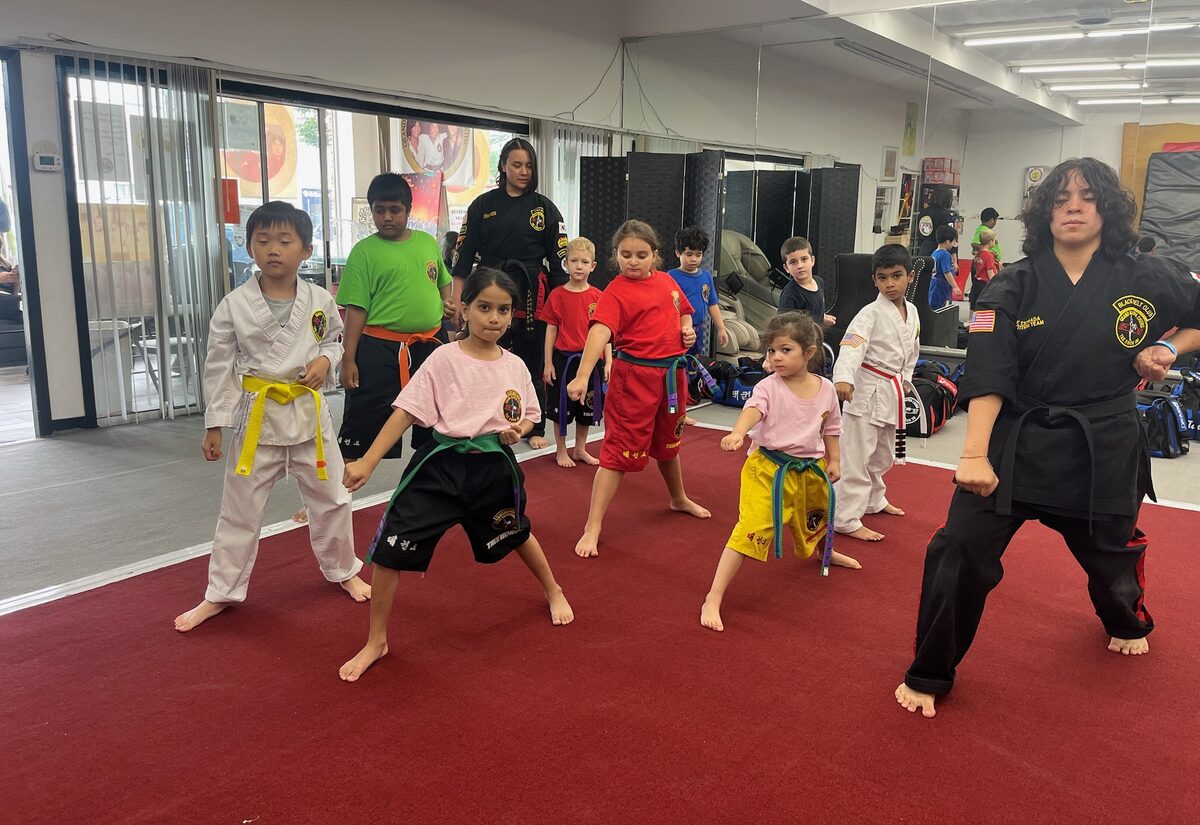
The best home practice is short and regular: a few sessions a week on your child's current form, stances, kicks and Korean words. At Chung TKD in New Hyde Park, each belt asks more in forms, technique and terminology, so practicing those at home helps most. Leave sparring and board breaking for class.
What should my child practice at home?
Practice what their current belt asks for. At every belt, children work on the same six areas: attendance, forms, technique, sparring drills, breaking and terminology. Three of them work well at home:
- Their form. The form for their belt, start to finish, slowly first (brown and black belts have two). From age 4, a white belt practices Chun-Ji.
- Stances and kicks. Holding a stance steady, then a few clean kicks on each leg, focusing on balance rather than height.
- Korean words. Counting to ten, the commands, and the names of the kicks.
For Pee-Wees, ages 2 to 3, keep it to kicks, balance and counting, as a game.
How long should a practice session be?
Short enough that your child wants to do it again. A few focused minutes beats a long session that ends in tears, especially for younger children. Stop while it's still fun.
What shouldn't my child practice at home?
Sparring and board breaking belong in class, with instructors and the right gear. At home, keep kicks in the air or toward a soft pillow held by an adult, clear some space, and practice barefoot rather than in socks on a smooth floor.
How can I help without being the instructor?
Be the audience, not the instructor. Ask your child to show you their form and to teach you a Korean word. Praise effort and focus, not how high the kick went. If something looks off, ask an instructor after class rather than correcting it at home.
Does practicing at home help my child earn stripes and belts?
Not directly, but it helps them get ready. Stripes come from classes where your child reviews their curriculum with an instructor, and an instructor checks readiness before each belt test. Below brown belt, your child tests when their instructors say they are ready. From brown belt on, tests are on set dates.
What if my child doesn't want to practice?
Don't force it. Make it a game: count kicks in Korean, have them teach a younger sibling a stance, or practice their form once before dinner. If practice keeps turning into a fight, let it rest and ask an instructor after class what to focus on.
Questions parents ask
What form should my child practice?
The form for their current belt, or both forms at brown and black belt. From age 4, a white belt practices Chun-Ji.
Is it safe to practice kicks at home?
Yes, with space, a clear floor and kicks in the air or at a soft pillow held by an adult. Leave sparring and breaking for class.
How do I know what my child is working on?
Ask an instructor after class. They can tell you what your child's belt asks for next.
For every form in order, read Tae Kwon Do belt colors in order.