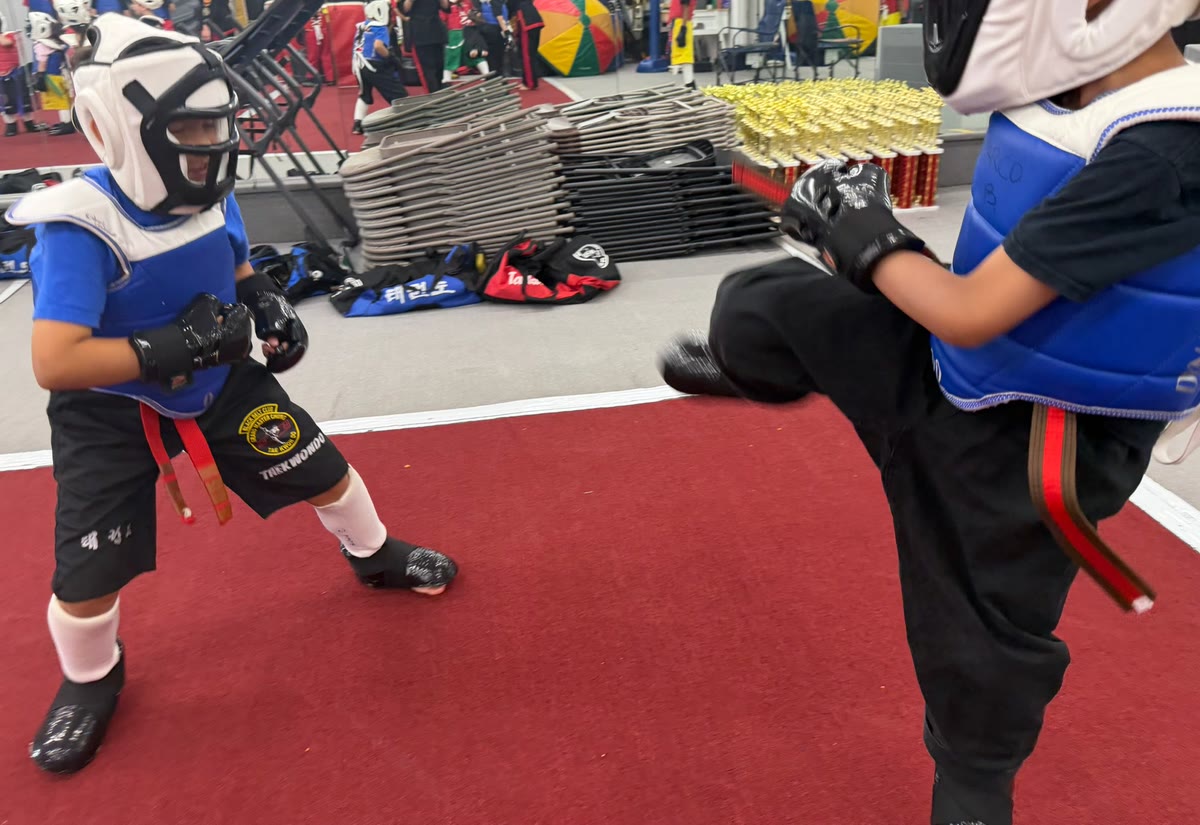
Tae Kwon Do is a Korean martial art and Olympic sport known for its high, jumping and spinning kicks. Muay Thai is a Thai martial art and full-contact combat sport that strikes with the fists, elbows, knees and shins and fights up close in the clinch.
Chung TKD in New Hyde Park teaches Tae Kwon Do, not Muay Thai, to children ages 2 to 13. Grandmaster Howard Chung, 9th Dan, has taught Tae Kwon Do since 1970 and opened the school in 1984. This guide is by Master Chris J. Chung, 5th-degree black belt.
How do Tae Kwon Do and Muay Thai compare for kids?
Both arts kick and punch, but Muay Thai also strikes with elbows and knees and fights in the clinch, where two fighters hold each other at close range, while Tae Kwon Do puts its weight on kicks. The table draws on Wikipedia's entries for Taekwondo, Muay Thai, clinch fighting and wai khru ram muay.
| Tae Kwon Do | Muay Thai | |
|---|---|---|
| Origin | Korean. Tae Kwon Do is a Korean martial art. | Thai. Muay Thai is sometimes called Thai boxing, and its other name, the art of eight limbs, refers to its use of the fists, elbows, knees and shins. |
| What each art teaches | Kicks, punches and blocks, and it is known above all for its kicks. | Punches, kicks, elbows and knees, plus sweeps and the clinch. |
| Kicks | Head-height, jumping and spinning kicks, and fast kicking. | The two most common kicks are the teep, a foot-thrust used to control distance, and the roundhouse kick, which turns the whole body and lands with the shin. |
| Elbows and knees | Not used in Olympic sparring, where the only techniques allowed are kicks, punches and pushes. | Both are part of the art, and elbows can strike from several angles. |
| Clinch | Sparring allows clinching for a short time or not at all. | Fighters are not separated when they clinch, and knee and elbow strikes are often used in the clinch. |
| Forms | Forms are set sequences of moves that show kicks, punches and blocks. | Before a match, fighters perform the wai khru ram muay, a ritual whose ram muay part is a series of choreographed movements that shows respect to the fighter's teacher. A Muay Thai fighter's training includes pad work, the heavy bag and sparring. |
| Ranks | Colored belts, then black belt degrees. | Some schools, especially in the West, use colored armbands called pra jiad to show rank. |
| Contact | Olympic sparring is full contact, and point sparring, which stops after each point, is light contact. | A full-contact sport. In training, sparring is often light to medium contact. |
Our guide to Tae Kwon Do sparring for kids explains how children build up to sparring.
At Chung TKD, color belts learn ITF forms, which the school calls hyung, and Kwang-Gae and Koryo are the black belt forms. Self-defense is part of class.
What is Muay Thai?
Muay Thai is a martial art from Thailand that uses stand-up striking, sweeps and clinching. It is sometimes called Thai boxing, and also the art of eight limbs, a name that refers to its use of the fists, elbows, knees and shins. Tae Kwon Do's own name describes its techniques too. Tae means to strike with the foot, kwon to strike with the hand, and do the way.
How are the kicks different?
Tae Kwon Do is known for head-height, jumping and spinning kicks and for fast kicking, while Muay Thai's two most common kicks are the teep and the roundhouse kick. Olympic Tae Kwon Do sparring awards extra points for spinning kicks and kicks to the head. Muay Thai's roundhouse kick turns the whole body and lands with the shin, and its teep, a foot jab, is used mainly as a defensive technique to control distance or block attacks. Muay Thai allows kicks below the waist, such as a low roundhouse kick to the leg, while Olympic Tae Kwon Do sparring does not permit a kick below the waist. In Muay Thai, low and middle roundhouse kicks are normally blocked with a raised shin, a block called a check.
Our guide to the basic Tae Kwon Do kicks and their names explains the kicks children learn in Tae Kwon Do.
What about elbows, knees and the clinch?
Strikes with the elbows and knees in the clinch are an important part of Muay Thai, and Olympic Tae Kwon Do sparring allows neither elbows nor knees. A clinch is when two fighters hold each other at close range. In Muay Thai, fighters are not separated when they clinch, and knee and elbow strikes are often used in the clinch. Olympic Tae Kwon Do sparring allows only kicks, punches and pushes, with no punches to the head, and Tae Kwon Do sparring allows clinching for a short time or not at all.
How does kickboxing compare with Tae Kwon Do?
Kickboxing and Tae Kwon Do both punch and kick, but kickboxing is a family of combat sports whose rules vary, and in the wide sense the word includes Muay Thai. The word itself was first used in Japan for a mix of Muay Thai and karate. Japanese kickboxing rules allow knees to the body and kicks below the waist, but no elbows and little or no clinch. American kickboxing allows only punches and kicks, and only above the waist. Tae Kwon Do has its own forms, belts and sparring rules. Like American kickboxing, its Olympic sparring does not permit a kick below the waist, and it scores kicks to the body and head and punches to the body. Wikipedia's entry on kickboxing lists the rule sets.
Is self-defense part of Tae Kwon Do and Muay Thai?
Yes, self-defense is part of both arts. Muay Thai's official history says it was developed by the Siamese army as a form of self-defense, and a typical Tae Kwon Do curriculum includes self-defense techniques beside forms, sparring and board breaking. Our page on self-defense for kids explains how self-defense fits into Tae Kwon Do class at Chung TKD.
How do you choose between Tae Kwon Do and Muay Thai for your child?
Start with what your child enjoys, then let a first class tell you more.
- A child who loves to kick, jump and spin may take to Tae Kwon Do, the art known for those kicks.
- A child who likes learning a routine may enjoy Tae Kwon Do's forms.
- A child who likes to work up close may enjoy Muay Thai's clinch and its elbow and knee strikes, and can ask a Muay Thai school what age it starts children.
The instructor and the class matter as much as the name of the art. Our guide to which martial art is best for kids compares Tae Kwon Do with karate, judo, Brazilian jiu-jitsu and kung fu, and our guide to Tae Kwon Do vs karate looks at those two arts side by side.
What should you ask at a first class?
These five questions work at a first class of either art.
- What age does the program start, and are classes grouped by age?
- Which techniques do children practice, and are elbows and knees part of it?
- How does sparring work for children, and how much contact does it use?
- Are there forms, and how do ranks or belts work?
- Can a parent watch, and is there a free trial class?
Trying Tae Kwon Do at Chung TKD
Chung TKD has three programs by age. Pee-Wee is for ages 2 to 3, Children is for ages 4 to 6 and Youth is for ages 7 to 13. New families start with two free trial classes, and a parent or guardian stays for both. Kids wear something comfortable, sweats or shorts, and the uniform comes if they sign up.
At Chung TKD, the belt after White is Gold. Testing day is held on the first Thursday of every month. A child tests when their instructors say they are ready. Grandmaster Chung runs every belt test, and our guide to how belt testing works in Tae Kwon Do explains what happens at a test.
Twice a year the school holds in-house tournaments with forms, sparring and breaking, which families watch.
Looking for Tae Kwon Do classes for kids near New Hyde Park? Chung TKD is at 1527 Jericho Turnpike, New Hyde Park, NY 11040. Book a free class online.
Questions parents ask
Is Muay Thai the same as Tae Kwon Do?
No. Muay Thai is a Thai art that strikes with the fists, elbows, knees and shins and fights in the clinch. Tae Kwon Do is a Korean art known above all for its kicks.
Does Muay Thai use belts?
Some Muay Thai schools, especially in the West, use colored armbands called pra jiad to show rank. Tae Kwon Do uses colored belts, then black belt degrees.
What is the clinch in Muay Thai?
The clinch is when two fighters hold each other at close range. Muay Thai puts much weight on strikes from the clinch, and fighters are not separated when they clinch.
Do Muay Thai and Tae Kwon Do both use the roundhouse kick?
Yes. Muay Thai's roundhouse kick is one of its two most common kicks, and it turns the whole body and lands with the shin. Tae Kwon Do also has a roundhouse kick, and in Olympic sparring a kick scores on the body and head.
Does Chung TKD teach Muay Thai?
No. Chung TKD teaches Tae Kwon Do to children ages 2 to 13 in New Hyde Park, and new families start with two free trial classes.